AI Ethics Rules for Lawyers: Florida vs Texas vs California
ABA Formal Opinion 512 summary side by side with Florida Op. 24-1, Texas Op. 705, California 2026 guidance, Alabama FO 2026-01. Consent, billing, agents.

Hellospark · Hellospark
15 min read ·
Disclaimer. This article is general information for lawyers about technology. It is not legal or ethics advice. Hellospark is a technology consultancy, not a law firm. Check the rules and opinions of every jurisdiction where you are licensed, and contact your bar's ethics hotline with specific questions. This post was drafted with AI assistance and reviewed by the Hellospark team, who checked every primary source named below. It does not include a personal first-hand anecdote.
In this article · 12 sections
- What terms should you know first?
- What does ABA Formal Opinion 512 require?
- How do Florida, Texas and California AI ethics rules compare?
- How do the consent rules differ in practice?
- How should lawyers bill for AI time?
- What about chatbots and AI agents?
- What about AI notetakers and recording consent?
- What is Alabama’s May 2026 AI guidance?
- What should you watch on December 1 and December 10, 2026?
- How do you use this hub without getting lost?
- Want help setting the tools up?
- Sources
- Frequently asked questions
Solo lawyers in Florida, Texas and California keep asking the same two questions: is it ethical for lawyers to use AI, and do the rules differ by state? Single-state pages answer the first. This hub answers the second.
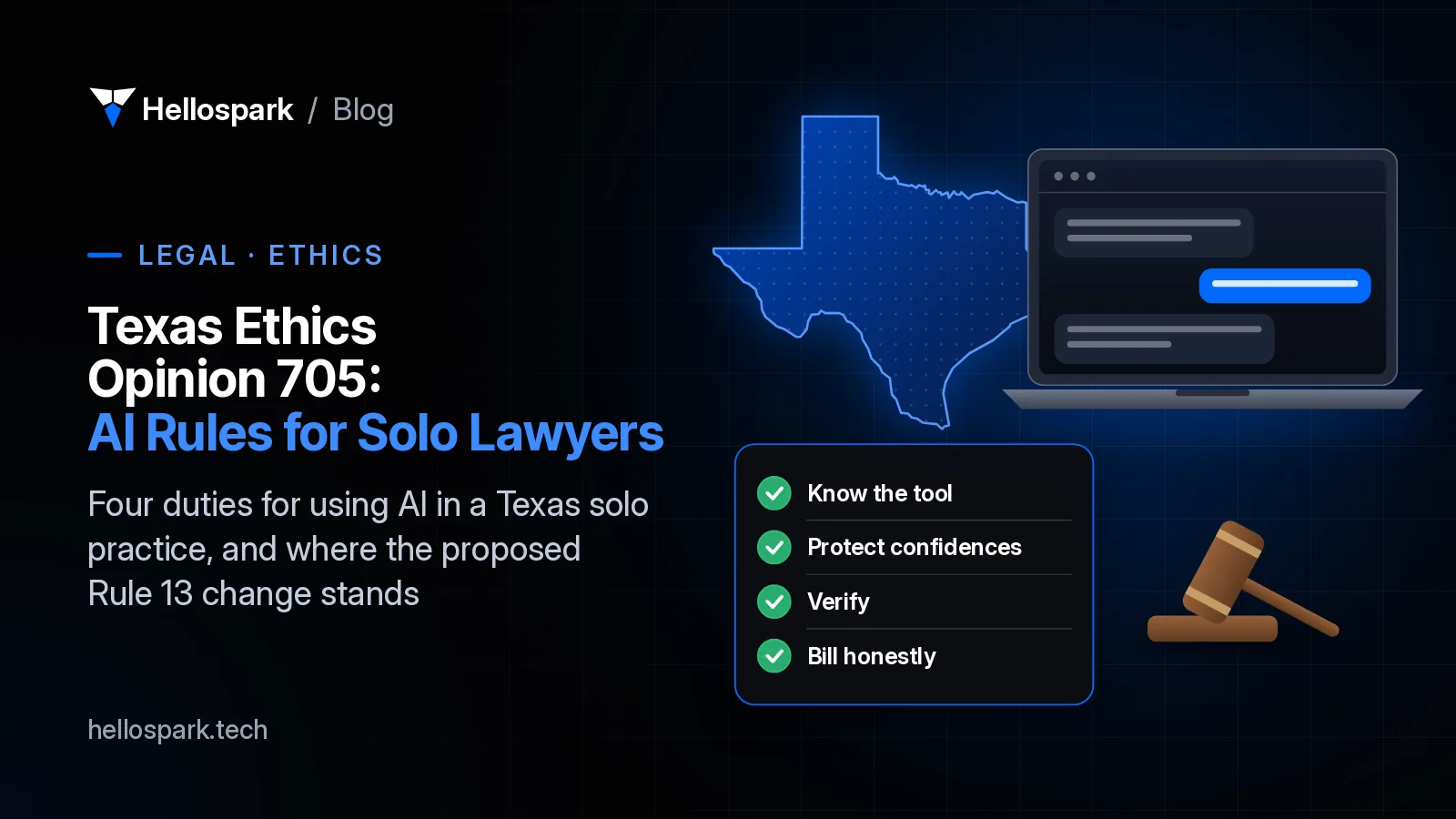
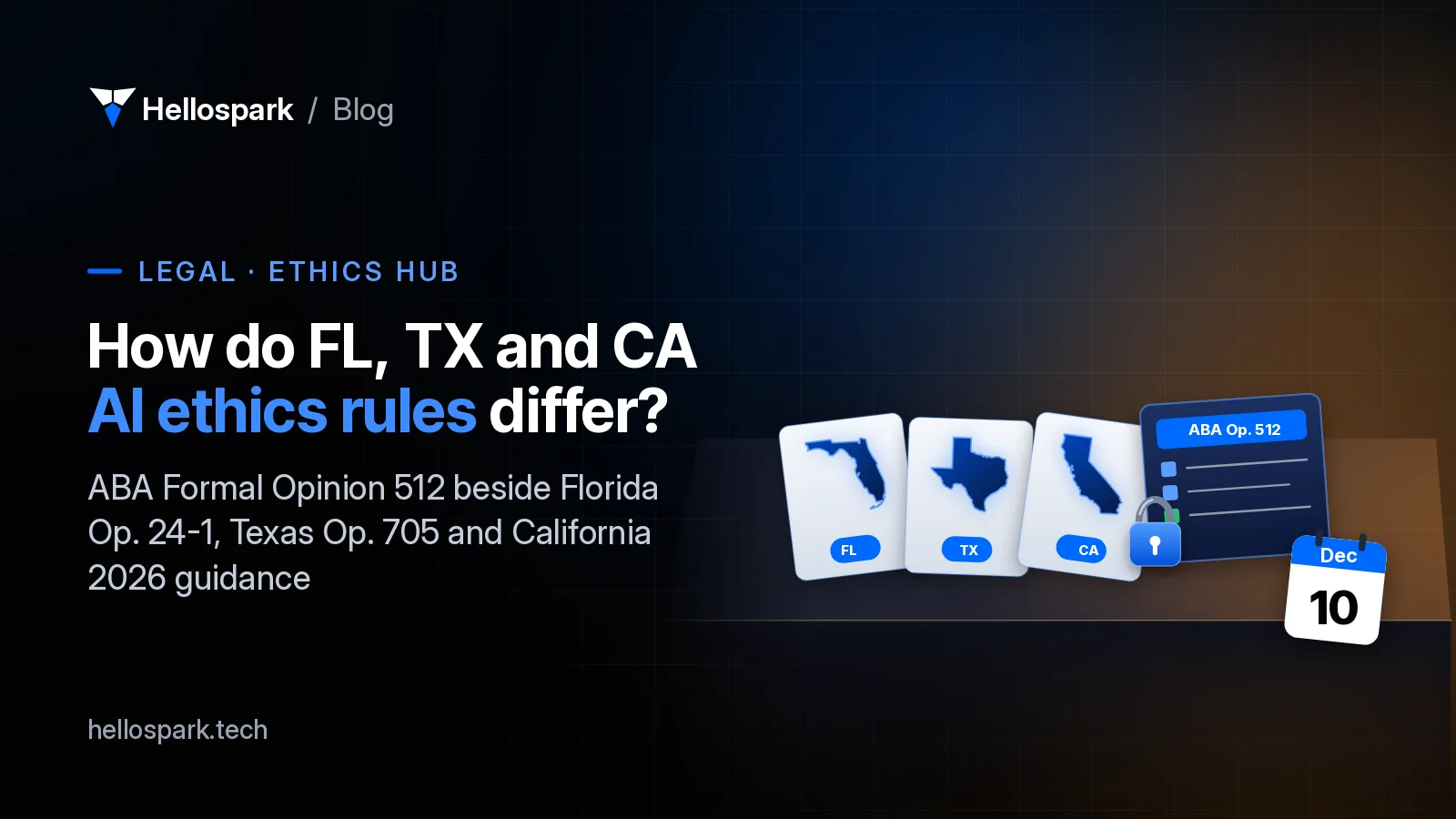
The national starting point is ABA Formal Opinion 512 (July 29, 2024). Florida already has Ethics Opinion 24-1 (January 19, 2024). Texas has Ethics Opinion 705 (February 2025). California has the State Bar’s 2026 Practical Guidance plus SB 574 (operative January 1, 2027). As an “other states” check, Alabama published AI best-practices guidance in May 2026 (PDF filename FO-2026-01).
Dated hook: The Florida Bar is soliciting member comments (postmarked by December 1) ahead of a Board Review Committee meeting on December 10, 2026. We will update this hub after that meeting. Until then, Opinion 24-1 is still Florida’s guidance.
We are a technology consultancy, not a law firm. We explain what the official texts say. The ethics calls are yours and your bar’s.
What terms should you know first?
- ABA Formal Opinion 512
- The American Bar Association Standing Committee on Ethics and Professional Responsibility's July 29, 2024 opinion on generative AI tools. It applies the Model Rules to competence, confidentiality, communication, supervision and fees. It does not bind a state bar by itself; your jurisdiction's rules and opinions do.
- Self-learning GAI
- Opinion 512's term for tools that can learn from what users put in, so one representation's information could later appear in answers to someone else.
- Agentic AI
- Tools that can plan and run multi-step tasks with less step-by-step prompting — for example drafting, emailing and calendaring without a fresh human click each time. California's 2026 guidance and Alabama's May 2026 guidance both address them; Florida's Dec 10 agenda may.
- Advisory opinion vs statute
- Florida 24-1 and Texas 705 are advisory ethics opinions. California's Practical Guidance is State Bar guidance. SB 574 is a California statute. Treat each source for what it is.
What does ABA Formal Opinion 512 require?
An ABA Formal Opinion 512 summary starts here. We read the full text via the ACC-hosted copy (rechecked Oct 29, 2026) (the americanbar.org PDF sometimes hits a bot challenge; use that path if it does).
Opinion 512’s lead line: lawyers using generative AI must consider duties of competent representation, protecting client information, communicating with clients, supervising employees and agents, advancing only meritorious claims, candor toward the tribunal, and charging reasonable fees.
Three lines solos quote most:
- Consent for self-learning tools. “A client’s informed consent is required prior to inputting information relating to the representation into such a GAI tool.”
- No boilerplate. “Merely adding general, boiler-plate provisions to engagement letters purporting to authorize the lawyer to use GAI is not sufficient.”
- Safe zone without client data. If you use the tool for idea generation without inputting information relating to the representation, informed consent is not required under that analysis.
On fees, Opinion 512 (drawing on Formal Opinion 93-379) says hourly billing must reflect time actually spent. Learning the tool is generally not billable as client time. A tool that works like general office equipment is overhead unless you told the client otherwise in advance; a matter-specific per-use charge can ordinarily be billed as an expense at the actual out-of-pocket cost. Explain the basis for any AI charge first, preferably in writing.
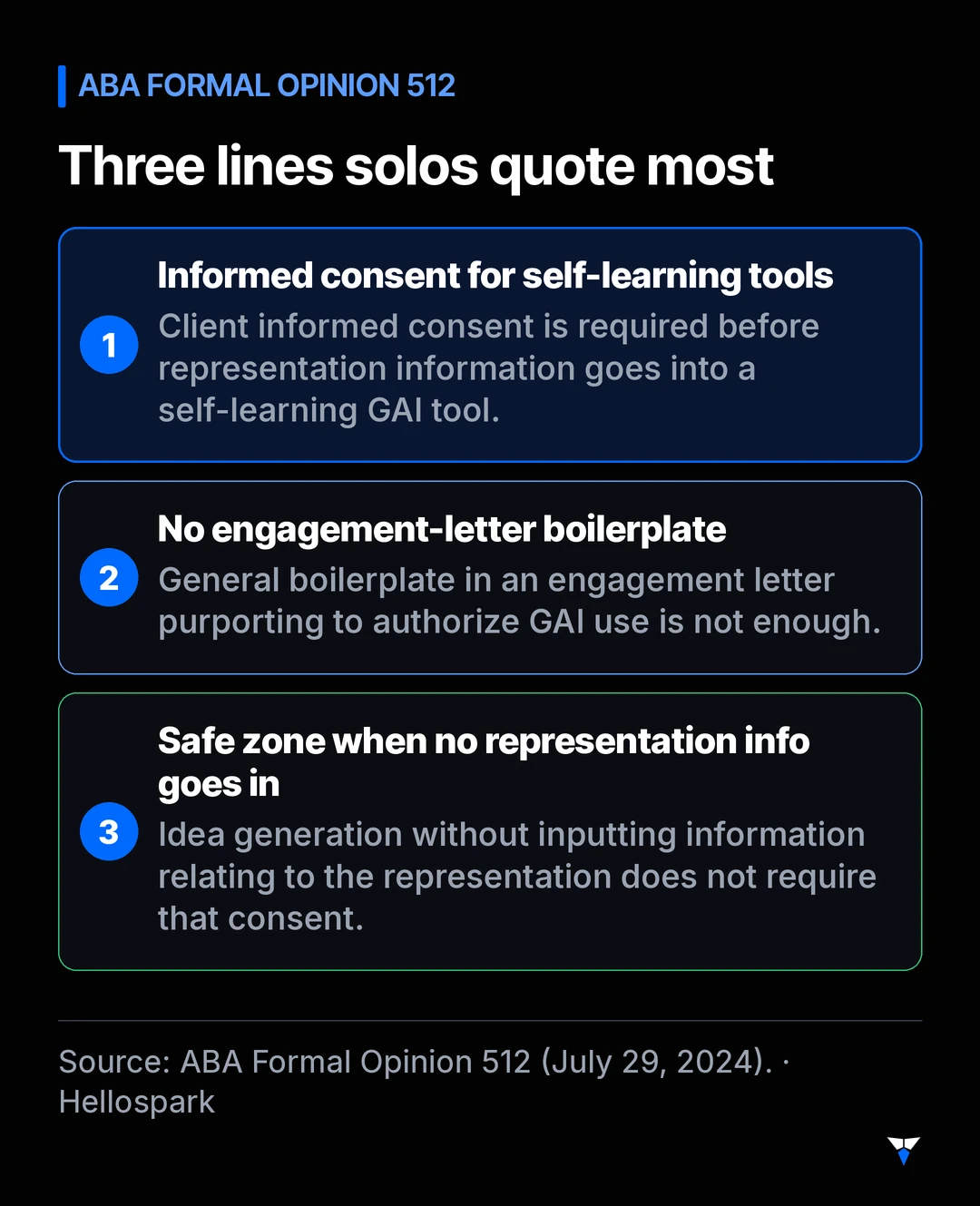
Three ABA Formal Opinion 512 lines solos quote most: informed consent for self-learning tools, no engagement-letter boilerplate, safe zone when no representation info goes in. Source: ABA Formal Op. 512 (July 29, 2024).
For plan-by-plan ChatGPT and Claude settings that sit under those consent rules, see Can lawyers use ChatGPT?.
How do Florida, Texas and California AI ethics rules compare?
This table is the hub. Each cell is a short reading of the named source. Where a source is silent on a dimension, we say so. Full checklists live in the state posts — do not treat this table as a substitute for them.
| Dimension | ABA Op. 512 (Jul 29, 2024) | Fla. Op. 24-1 (Jan 19, 2024) | Tex. Op. 705 (Feb 2025) | Cal. 2026 Practical Guidance + SB 574 | Alabama May 2026 guidance (FO-2026-01 PDF) |
|---|---|---|---|---|---|
| Consent / confidentiality | Informed consent before representation information goes into a self-learning tool; boilerplate not enough | Recommends informed consent before confidential info goes to a third-party generative AI; not required if no confidential info goes to a third party | Be “reasonably satisfied” the program will not reveal confidences; if not, at minimum no input without client consultation and consent; consider informing clients | Guidance: informed consent where material confidentiality risk; must consider disclosing intended AI use. SB 574 (from Jan 1, 2027): no confidential / personal identifying / nonpublic info into systems unless access is restricted to the attorney and authorized people | Obtain informed consent when confidentiality risks cannot be eliminated; prefer enterprise / closed systems |
| Billing | Bill actual time spent; generally do not bill learning time; office-like tools are overhead; per-use costs at actual cost, basis explained first | No double-billing or inflated hours; may bill reasonable case-specific AI time, not time learning the tool; disclose AI cost pass-through; consider flat / contingent fees | May charge actual time using the tool (including refining and checking); may not charge hourly for time “saved”; per-use expenses only as allowed and accepted, generally at actual cost | Bill actual time on prompts and review; general AI subscriptions typically overhead; matter-specific per-use at actual cost with disclosure (no markup without informed written consent). SB 574 is silent on fees | Bill only time actually spent, including review; do not bill time saved; treat subscriptions as overhead unless agreed otherwise |
| Chatbots | Mentions Florida’s chatbot advertising concerns in a footnote; no separate chatbot rule of its own | Intake / website chatbots must say they are an AI program, not a lawyer or employee; be wary of a chatbot that may give legal advice; consider screening questions for already-represented people | Silent as a dedicated chatbot rule in Op. 705 (the State Bar’s AI toolkit separately offers a sample chatbot disclaimer) | Agentic / intake examples under agent rules; no Florida-style “must label chatbot” sentence in the guidance pages we checked | Website chatbot that gives specific legal advice without saying it is not an attorney and without lawyer review may raise UPL / supervision issues |
| Agents | Supervisory duties cover employees and agents; opinion is mainly about generative tools | Silent in 24-1; Dec 10, 2026 agenda may cover agentic AI | Silent on “agentic” by name; verification and Rule 5.03 nonlawyer-assistant analogy still apply | Detailed: no substantive legal determinations, legal advice or filings without meaningful lawyer supervision and review; no autonomous external transmission of client information without appropriate safeguards and human review | Dedicated agentic section: human review checkpoint before actions; define authorized tasks in writing; audit logs |
| Supervision | Managerial and supervisory lawyers must make reasonable efforts so firm lawyers and nonlawyers comply when using GAI | Treat AI like a nonlawyer assistant (Rule 4-5.3 analogy); policies and review | Compare reliance on AI to inexperienced nonlawyer assistants (Rule 5.03) | Managerial lawyers should set clear AI policies and training; subordinate lawyers may not use AI-enabled tools including agents inconsistently with the rules | AI as nonlawyer assistant under ARPC 5.1 / 5.3; written policies; no unsupervised staff submission of AI work |
| Recording / notetaker consent | Silent on call-recording statutes | 24-1 silent on recording statutes; Dec 10 agenda may cover AI tools that record, transcribe and summarize; Fla. Stat. 934.03 is all-party consent (see notetaker guide) | Op. 705 silent on recording statutes; Texas criminal law is generally one-party (ethics still require confidentiality analysis) | Guidance silent on Pen. Code 632; California confidential-call recording still needs all-party consent (see notetaker guide) | Silent on recording statutes |
State deep-dives (use each post’s own keyword, not this hub’s):
- Florida → Florida Bar AI rules: Opinion 24-1 checklist
- Texas → Texas Ethics Opinion 705
- California → California State Bar AI guidance and SB 574
- Call recording → AI notetaker for lawyers
How do the consent rules differ in practice?
Short version: ABA and Florida push hardest toward informed consent before client information leaves your control; Texas is “reasonably satisfied, else consult and consent”; California adds a statutory access restriction from 2027.
| Source | Consent / disclosure line (paraphrased from the text) |
|---|---|
| ABA Op. 512 | Informed consent before representation info into a self-learning tool; engagement-letter boilerplate is not enough |
| Fla. Op. 24-1 | Recommended informed consent before confidential info to a third-party generative AI |
| Tex. Op. 705 | Reasonably satisfied the program will not reveal confidences; otherwise at minimum consultation and consent; “should consider informing” clients |
| Cal. 2026 guidance | Consider disclosing intended AI use, how, and benefits and risks; informed consent where material confidentiality risk |
| Cal. SB 574 (from Jan 1, 2027) | Do not enter confidential / personal identifying / nonpublic info unless access is restricted to the attorney and authorized confidential people |
| Alabama May 2026 | Informed consent when confidentiality risks cannot be eliminated |
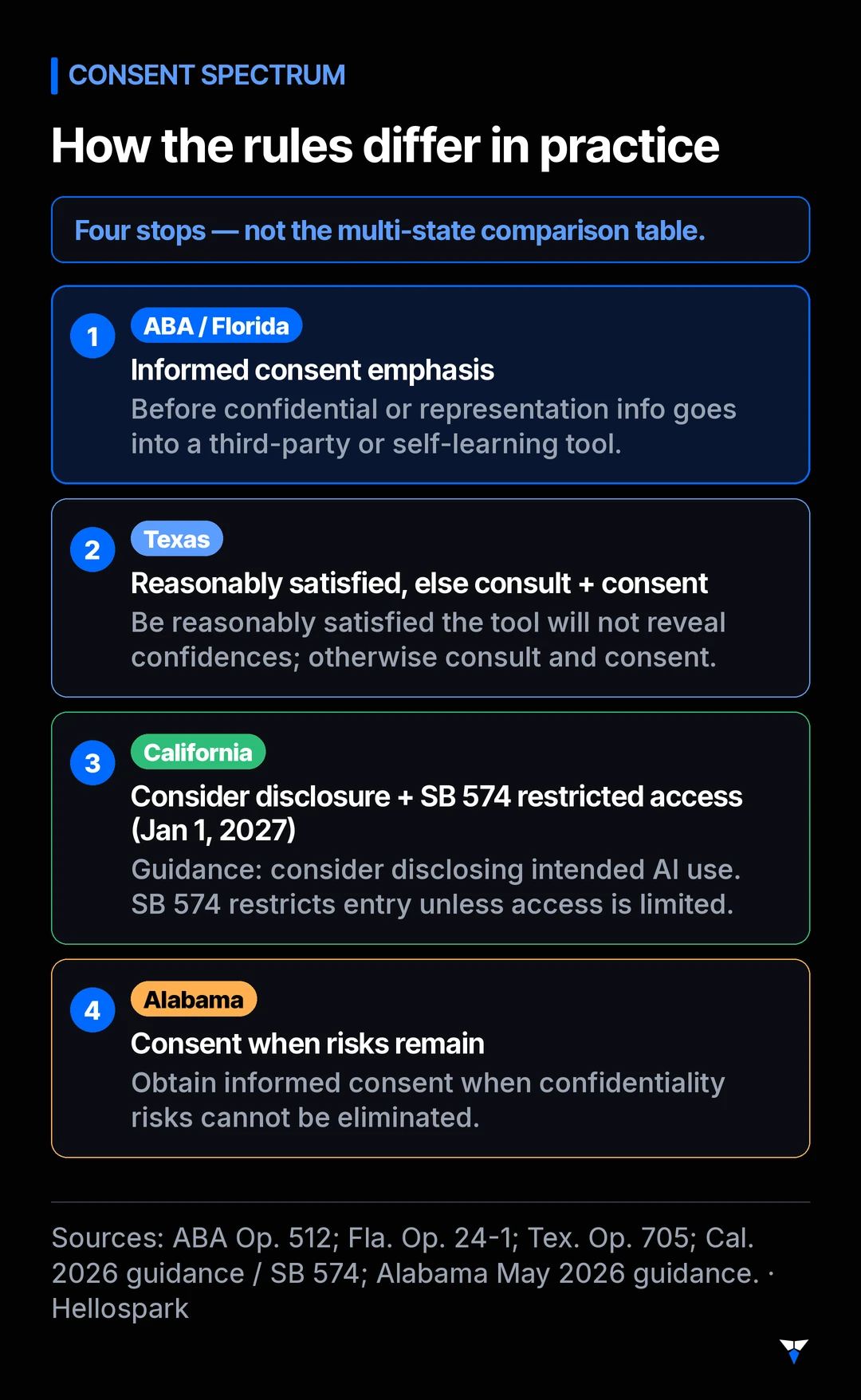
Consent spectrum for AI and client information: ABA/Florida informed-consent emphasis → Texas “reasonably satisfied” test → California disclosure plus SB 574 restricted access from Jan 1, 2027. Sources linked in the table above.
None of these texts is a ban on AI. They are conditions on how you use it.
How should lawyers bill for AI time?
All five sources agree on the core idea: bill the time you actually spent (including review), not the hours the tool saved you. Texas says it almost word for word (no hourly fees for time “saved”); Florida says efficiency “must not result in falsely inflated claims of time.” ABA 512 and California’s guidance treat general, office-like AI tools as overhead in typical cases. Alabama’s May 2026 guidance matches that pattern.
Florida also says to tell clients, preferably in writing, if you intend to charge the actual cost of an AI tool, and suggests considering flat or contingent fees so efficiency benefits both sides. Texas allows passing through per-use AI expenses only as allowed by law and accepted by the client, generally at no more than actual cost.
A dedicated billing comparison post is queued separately; this hub only needs the side-by-side above so engines can quote the differences.
What about chatbots and AI agents?
Chatbots. Florida is the clearest: a chatbot that talks to prospective clients must say it is an AI program, not a lawyer or law firm employee. Florida also warns against an overly welcoming chatbot that may give legal advice, and suggests screening questions for people who already have a lawyer. Alabama warns that a website chatbot giving specific legal advice without attorney review can raise unauthorized-practice and supervision problems. Texas Opinion 705 does not write a chatbot rule; the State Bar’s AI toolkit publishes a sample chatbot disclaimer separately. ABA 512 points at Florida’s advertising discussion in a footnote rather than writing its own chatbot checklist.
Agents. California’s 2026 guidance is the most detailed of the three focus states: do not let an agent make substantive legal determinations, communicate legal advice, or prepare and file pleadings without meaningful lawyer supervision and review, and do not let it send client information outward on its own without appropriate safeguards and human review. Alabama’s guidance adds written task limits, human checkpoints and activity-log audits. Florida Opinion 24-1 is silent on agents; agentic AI is the first of four possible topics for the December 10, 2026 meeting. Texas Opinion 705 does not use the word “agentic,” but its verification and nonlawyer-assistant supervision analysis still apply.
Our house practice when we set tools up for lawyers: the AI may draft, sort and summarize; a lawyer approves anything that leaves the office. That is our technology practice, not a bar rule.
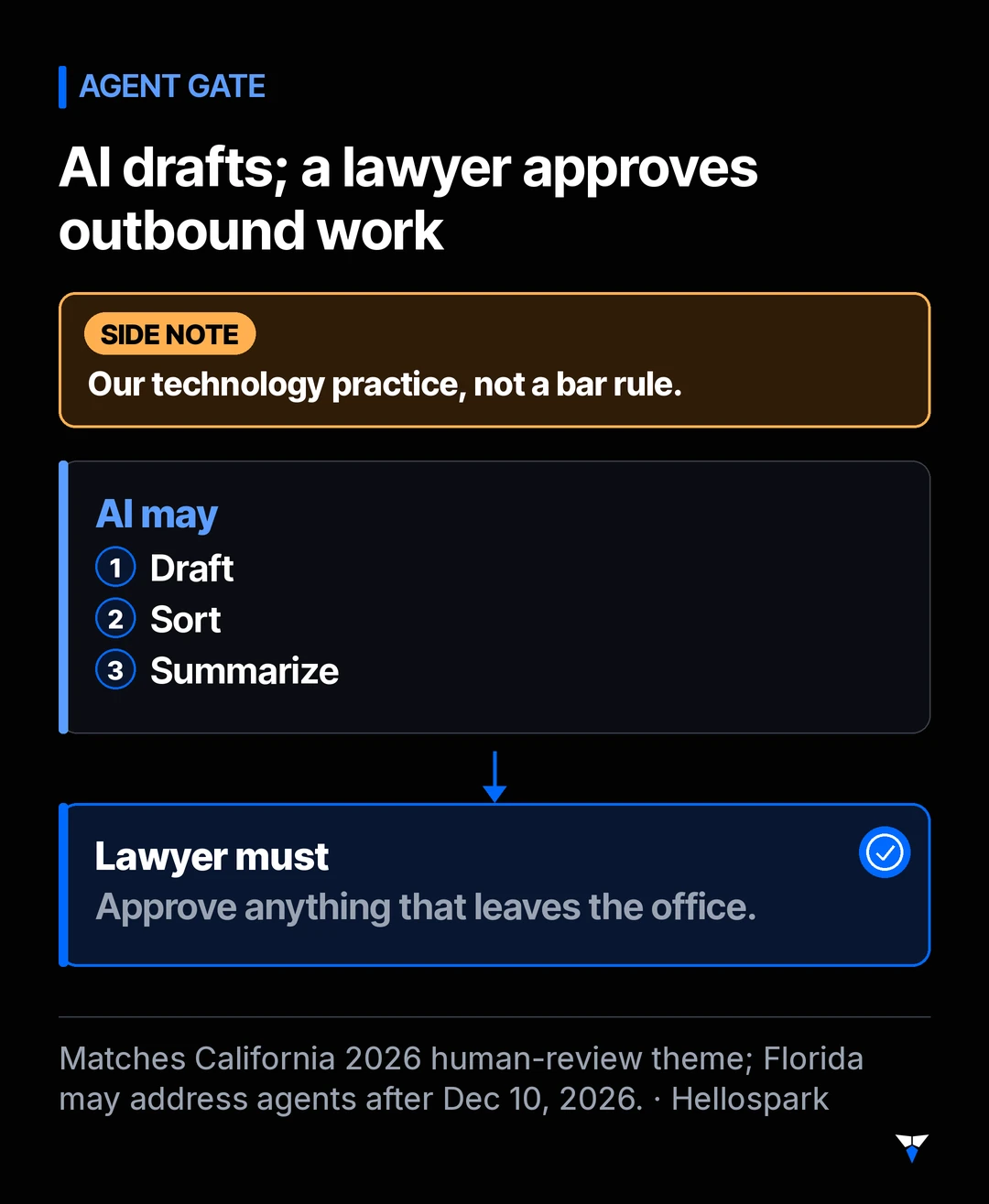
Agent gate: AI may draft, sort and summarize; a lawyer approves anything that leaves the office. Matches the California 2026 guidance’s human-review theme; Florida may address agents after Dec 10, 2026.
What about AI notetakers and recording consent?
Most of the ethics opinions in the table are silent on wiretap / recording statutes. They talk about confidentiality and third-party tools; they do not rewrite Fla. Stat. 934.03, Texas Penal Code 16.02 or California Penal Code 632.
Practical recording rules still matter:
- Florida and California are all-party consent states for the relevant call-recording provisions.
- Texas is generally one-party for the criminal statute, but Opinion 705’s confidentiality analysis still applies to where the audio and transcript go.
- Florida’s Dec 10 agenda may cover AI tools that record, transcribe and summarize communications.
For the statute-level detail and a consent script habit, use our AI notetaker for lawyers guide — that post owns the recording keywords.
What is Alabama’s May 2026 AI guidance?
Alabama sits in this hub as an other-states row, not as a third focus jurisdiction. The Alabama State Bar published Artificial Intelligence Use: Best Practices Under Existing Professional Conduct Rules (PDF creation metadata May 13, 2026; filename FO-2026-01.pdf). The document title on the PDF is best-practices guidance applying existing Alabama Rules of Professional Conduct; it is listed under the Bar’s formal-opinions path.
Useful points for comparison:
- AI “does not create new ethical duties”; it recontextualizes competence, confidentiality, supervision, candor, fees and communication.
- Prefer enterprise / closed systems over free consumer tools when client information is involved.
- Independent verification of every AI citation before filing.
- Dedicated agentic-AI section with human checkpoints.
- Chatbot UPL / supervision warning.
- Silent on call-recording statutes (same gap as ABA 512 and Texas 705).
Citation-checking tools can help with that verification step, but they don’t replace it. Anthropic’s Cite check artifact for Claude (announced October 28, 2026) flags quotes that don’t match, wrong page numbers and sources that don’t support the claim, and Anthropic itself describes Claude’s output as a first pass that a lawyer then applies judgment to. The duty to verify before filing stays with you under Alabama’s guidance, Texas Opinion 705 and ABA Opinion 512’s candor duty.
If you are licensed only in Alabama, read the PDF itself; this hub only uses it as a cross-check row.
What should you watch on December 1 and December 10, 2026?
On October 15, 2026, The Florida Bar announced that, following an inquiry by its Special Committee on Artificial Intelligence (AI) Tools and Resources, the Board Review Committee on Professional Ethics will consider a proposed advisory opinion at the Board of Governors’ direction:
- Meeting: Thursday, December 10, 2026, 1–3 p.m., Omni Amelia Island
- Comments: email eto@floridabar.org or write Ethics Counsel Jonathan Grabb; comments must be postmarked by December 1
- Possible topics: agentic AI; AI tools that record, transcribe and summarize communications; guidance to clients about their own AI use; updates to Opinion 24-1
- Drafts at announcement: none
That is a committee meeting date, not a compliance deadline for lawyers. Until a new opinion is adopted, Opinion 24-1 remains the Florida guidance.
Update after Dec 10: we will revise this hub (and the Florida post) after the meeting with whatever the committee publishes or announces. If nothing is adopted that day, we will say so.
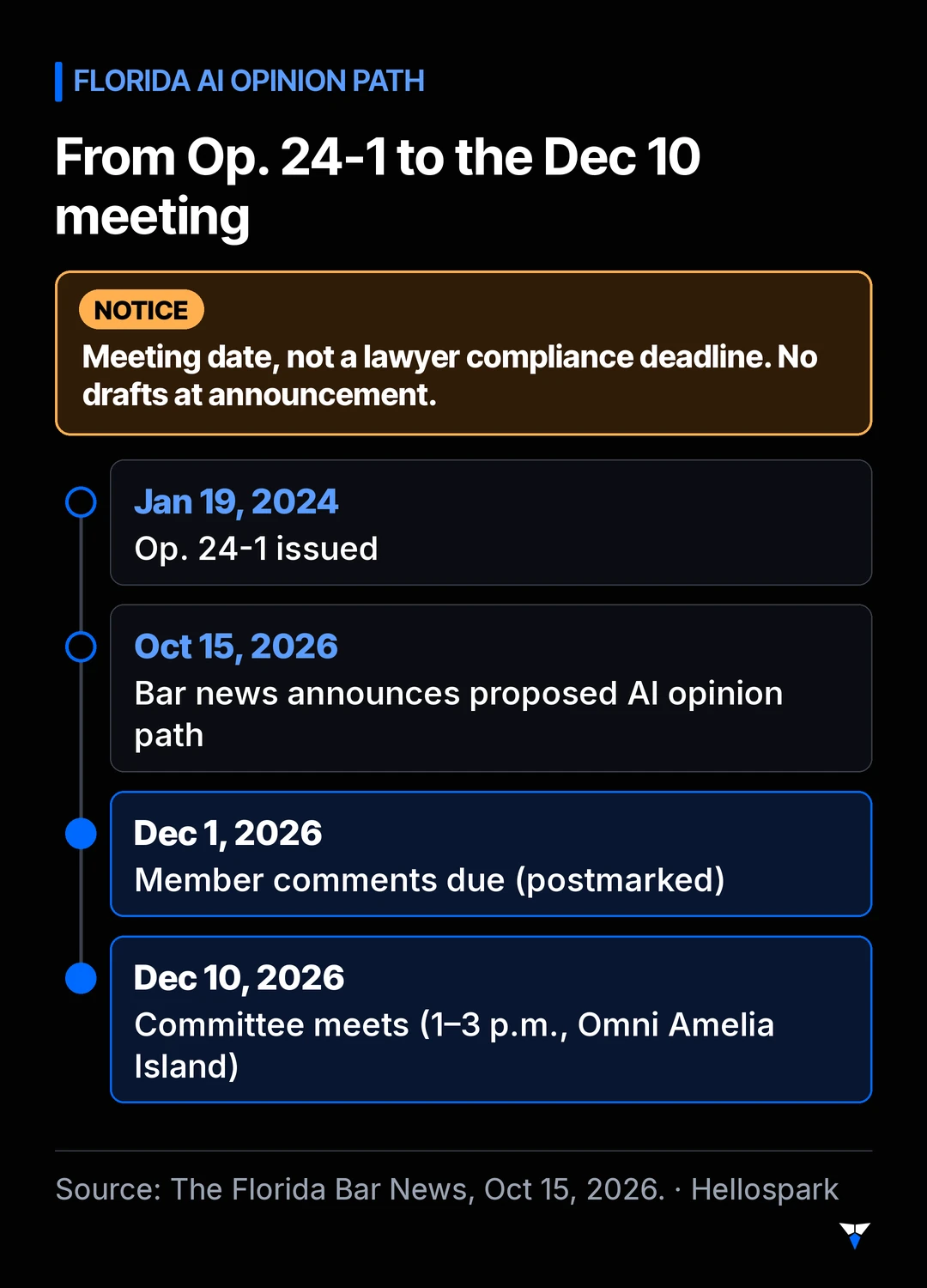
Florida AI opinion timeline: Op. 24-1 (Jan 19, 2024) → Bar news Oct 15, 2026 → comments due Dec 1 → committee meets Dec 10, 2026. Source: The Florida Bar News, Oct 15, 2026.
How do you use this hub without getting lost?
- Start with Opinion 512 if you need the national vocabulary (self-learning tools, no-boilerplate consent, reasonable fees).
- Open your state’s post for the checklist that matches your license.
- Check recording separately via the notetaker guide before any AI joins a call.
- Gate outbound work. Drafts stay in a review folder until you approve them.
- Re-read after Dec 10, 2026 if you practice in Florida.
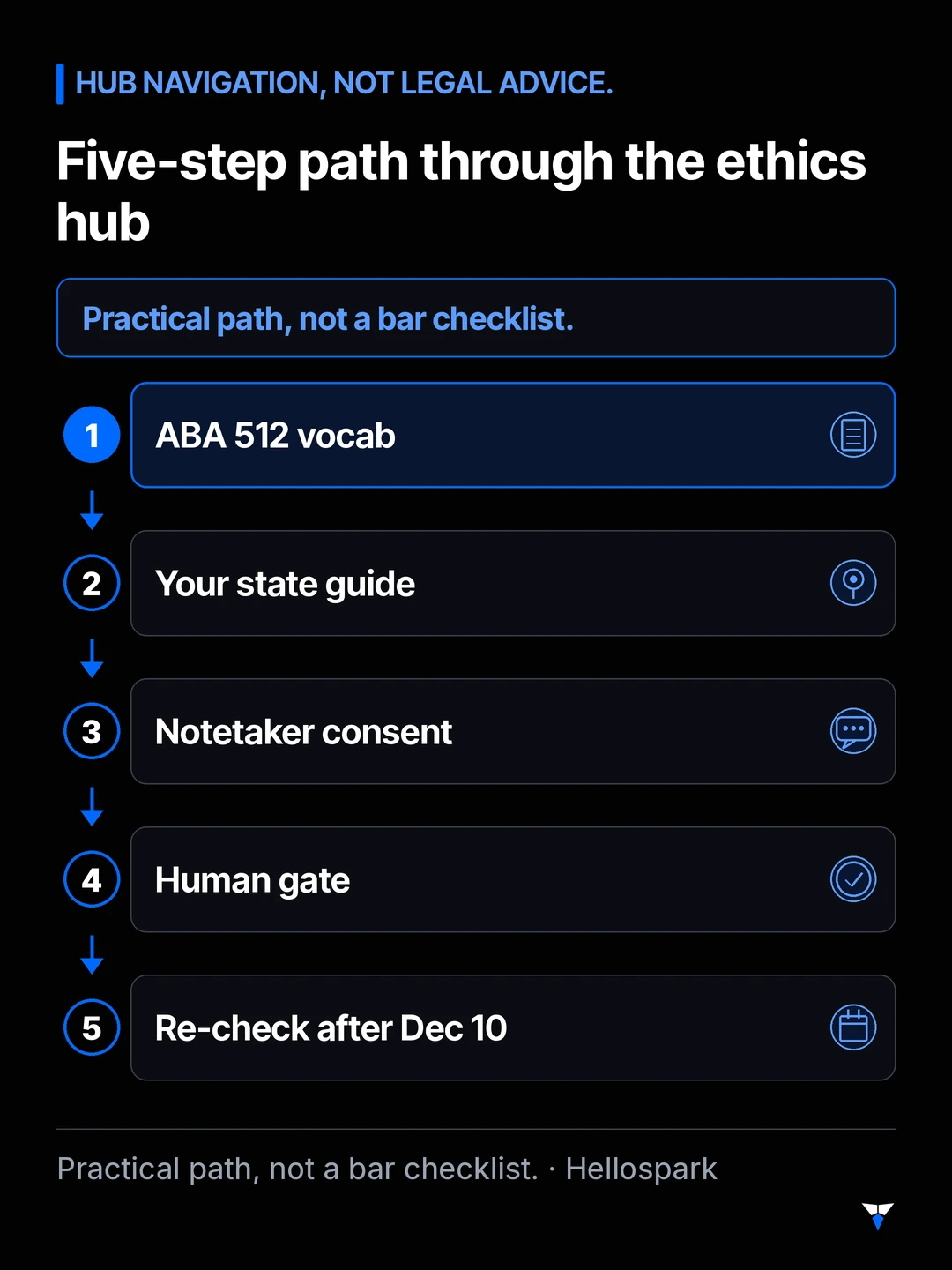
Five-step hub path: ABA 512 vocabulary → your state guide → notetaker consent → human gate on outbound work → re-check Florida after Dec 10. Practical path, not a bar checklist.
Want help setting the tools up?
We configure privacy settings and draft-vs-send workflows with you, in your own accounts, in a 1-hour, 1:1 AI setup session ($100), and you leave with a written plan. Not sure it fits your practice? Book the free 15-minute fit call first, or see all booking options.
Sources
- American Bar Association, Formal Opinion 512: Generative Artificial Intelligence Tools (July 29, 2024). Text rechecked Oct 29, 2026 via the ACC copy (americanbar.org PDF sometimes hits a bot challenge). News summary: ABA issues first ethics guidance on a lawyer’s use of AI tools.
- The Florida Bar, Ethics Opinion 24-1 (January 19, 2024) and full-text PDF (both rechecked Oct 29, 2026).
- The Florida Bar, Proposed advisory opinion on Artificial Intelligence tools (October 15, 2026) — Dec 1 comment deadline; Dec 10, 2026 meeting.
- Texas Professional Ethics Committee, Opinion 705 (February 2025) and PDF. State Bar of Texas, sample chatbot disclaimer (AI toolkit).
- State Bar of California, Practical Guidance for the Use of Generative Artificial Intelligence in the Practice of Law (2026) (Board of Trustees approved updated revisions May 14, 2026).
- California Legislature, SB 574 (Chapter 858, Statutes of 2026; approved Sep 30, 2026; operative Jan 1, 2027 under the usual California rule for non-urgency chaptered bills).
- Alabama State Bar, Artificial Intelligence Use: Best Practices Under Existing Professional Conduct Rules (May 2026; PDF FO-2026-01.pdf, creation metadata May 13, 2026).
- Anthropic, Introducing artifacts for legal work (October 28, 2026), Cite check description.
- Related Hellospark guides: Florida Bar AI rules, Texas Ethics Opinion 705, California State Bar AI guidance, AI notetaker for lawyers, Can lawyers use ChatGPT?.
Frequently asked questions
What does ABA Formal Opinion 512 say about lawyers using AI?
ABA Formal Opinion 512 (July 29, 2024) says lawyers may use generative AI if they meet existing duties: competence with the tool's benefits and risks, confidentiality, client communication, supervision of people and tools, meritorious claims and candor to the tribunal, and reasonable fees. Informed consent is required before inputting information relating to the representation into a self-learning GAI tool, and general boilerplate in an engagement letter is not enough.
Is it ethical for lawyers to use AI in Florida, Texas or California?
Yes, under each state's current texts. Florida Ethics Opinion 24-1 (Jan 19, 2024), Texas Ethics Opinion 705 (February 2025) and the California State Bar's 2026 Practical Guidance (plus SB 574 from Jan 1, 2027) all allow generative AI use while applying confidentiality, verification, billing and supervision rules. None of them bans AI.
Do Florida, Texas and California require the same client consent for AI?
No. ABA Opinion 512 and Florida Opinion 24-1 push hardest toward informed consent before confidential or representation information goes into a third-party or self-learning tool. Texas Opinion 705 says you should be reasonably satisfied the tool will not reveal confidences, and if not, at a minimum get client consultation and consent. California's guidance says consider disclosure of intended AI use; from Jan 1, 2027 SB 574 also restricts entry of confidential and personal identifying information into systems whose access is not limited to the attorney and authorized people.
What is changing at the Florida Bar on December 10, 2026?
On October 15, 2026 The Florida Bar said its Board Review Committee on Professional Ethics will consider a proposed advisory opinion on December 10, 2026 (1–3 p.m., Omni Amelia Island). Topics may include agentic AI, AI recording/transcription/summarization tools, guidance about clients' own AI use, and updates to Opinion 24-1. There were no drafts at announcement. Member comments must be postmarked by December 1. Until something new is adopted, Opinion 24-1 remains the Florida guidance.
Where should I read the full Florida, Texas or California guide?
Use this hub for the side-by-side table. For state detail, read our Florida Bar AI rules checklist, Texas Ethics Opinion 705 guide and California State Bar AI guidance and SB 574 checklist. For call recording, see the AI notetaker for lawyers guide. For ChatGPT/Claude plan settings, see Can lawyers use ChatGPT?

Written by Hellospark
Hellospark (a Spark Tech company)
Hellospark (a Spark Tech company) is an AI and automation consultancy in Marrakech. We write practical guides so solo professionals can set up AI for admin without drowning in paperwork.
Want AI set up for your work?
One 1:1 video hour with a founder to set up AI for your admin. $100, paid when you book.
Get plain-English AI tips for your business
Simple guides to using AI for your admin, written by the two founders. No spam; about one email a month.