Florida Bar AI rules: an Opinion 24-1 checklist for solo lawyers
What Florida Bar Opinion 24-1 requires when solo lawyers use AI: client consent, chatbots, billing and review, plus the Dec 10, 2026 proposed opinion.

Ayoub El Mardi · Co-founder, Spark Tech
8 min read · · Updated
Last updated
Updated : named Hellospark in the intro disclaimer (brand rule).
Earlier updates (4)
- : named Spark Tech in the intro disclaimer.
- : added three explanatory visuals.
- : shortened the AI notetaker section and linked our new guide to consent rules in Florida, Texas and California.
- : rewritten as a Florida-first guide; added consent, chatbot, committee and CLE answers from Opinion 24-1 and the Bar's CLE rules.
Disclaimer. This article is general information for lawyers about technology. It is not legal or ethics advice. Hellospark is a technology consultancy, not a law firm. Check the rules and opinions of every jurisdiction where you are licensed, and contact your bar's ethics hotline with specific questions.
In this article · 11 sections
- What are the Florida Bar’s rules on lawyers using AI?
- Does a Florida lawyer need client consent to use AI?
- Does a law firm chatbot in Florida have to say it’s AI?
- How should Florida lawyers bill for AI-assisted work?
- Can you use an AI notetaker on client calls?
- What about AI agents?
- Does Florida require AI CLE?
- What is the Florida Bar changing? (Dec 10, 2026 meeting)
- How do you set up AI safely in a solo practice?
- Where to go from here
- Sources
- Frequently asked questions
If you run a solo or small practice in Florida, AI can take a real share of the evening work: first drafts of client emails, summaries of long documents, intake and scheduling. The question is whether using it could get you into ethics trouble. Florida’s answer today is Ethics Opinion 24-1, and a new opinion is on the Bar’s agenda for December 10, 2026.
Hellospark, a small AI consultancy for US solo professionals, explains how the tools work and where the risks sit. We are not a law firm. The ethics calls are yours and your bar’s.
What are the Florida Bar’s rules on lawyers using AI?
Opinion 24-1 (January 19, 2024) says lawyers may use generative AI, but must protect client confidentiality, provide accurate and competent work, avoid improper billing and follow the advertising rules. Here it is as a checklist:
| Duty | What it means for you | Where it comes from |
|---|---|---|
| Competence | Understand what the tool can and cannot do before you rely on it, and keep up as it changes. | Fla. Op. 24-1 (Rule 4-1.1); ABA Op. 512 |
| Confidentiality | Research the tool’s data retention, data sharing and “self-learning” policies. Florida recommends informed consent before confidential information goes to a third-party AI tool. | Fla. Op. 24-1 (Rule 4-1.6); ABA Op. 512 |
| Verify everything | You are responsible for the work product. Check facts and citations before anything goes to a client, opponent or court. Don’t tell a client to rely on an AI report without your own review. | Fla. Op. 24-1; Cal. 2026 guidance |
| Supervision | Treat AI like a nonlawyer assistant: set policies and review its work. | Fla. Op. 24-1 (by analogy to Rule 4-5.3) |
| Reasonable fees | No double-billing or inflated hours, and no charging for time spent learning the tool. | Fla. Op. 24-1 (Rule 4-1.5); ABA Op. 512 |
| Chatbots | An intake or website chatbot must say it is an AI program, not a lawyer or employee. | Fla. Op. 24-1 |
| Advertising | You may say you use AI. Don’t claim your AI is better than other firms’ unless you can prove it. | Fla. Op. 24-1 (Rule 4-7.13) |
Advisory opinions are not binding in themselves (24-1 says so on its first line), but they explain how the binding rules apply. The same core points appear in ABA Formal Opinion 512 (July 29, 2024).
Does a Florida lawyer need client consent to use AI?
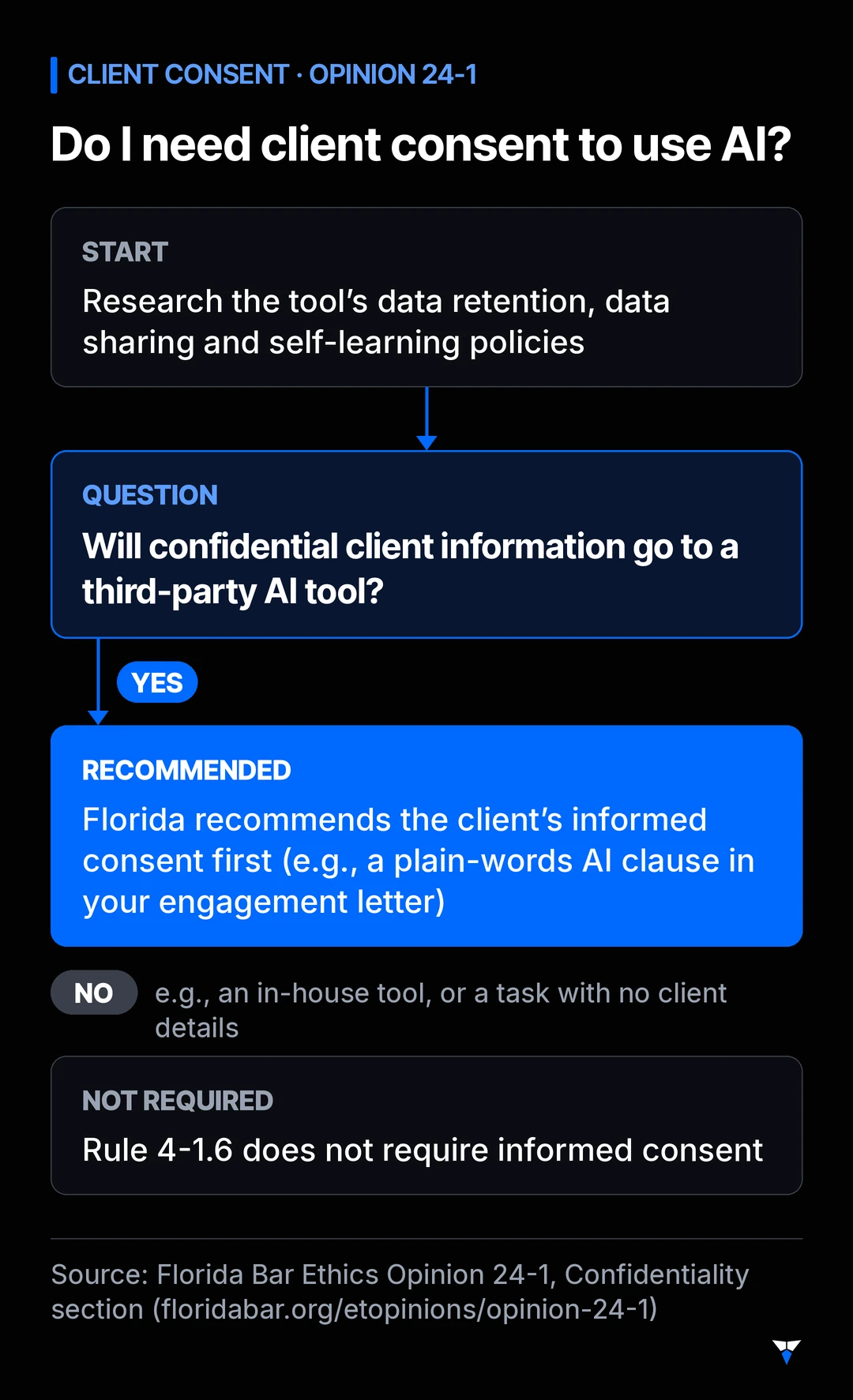
Not always. Opinion 24-1 recommends informed consent before you use a third-party AI tool in a way that would disclose confidential information. If no confidential information goes to a third party, for example a tool you host yourself or a task with no client details, Rule 4-1.6 does not require informed consent. Either way, research the tool’s data retention, data sharing and “self-learning” policies first. A plain-words AI clause in your engagement letter is a simple way to get consent up front.
Does a law firm chatbot in Florida have to say it’s AI?
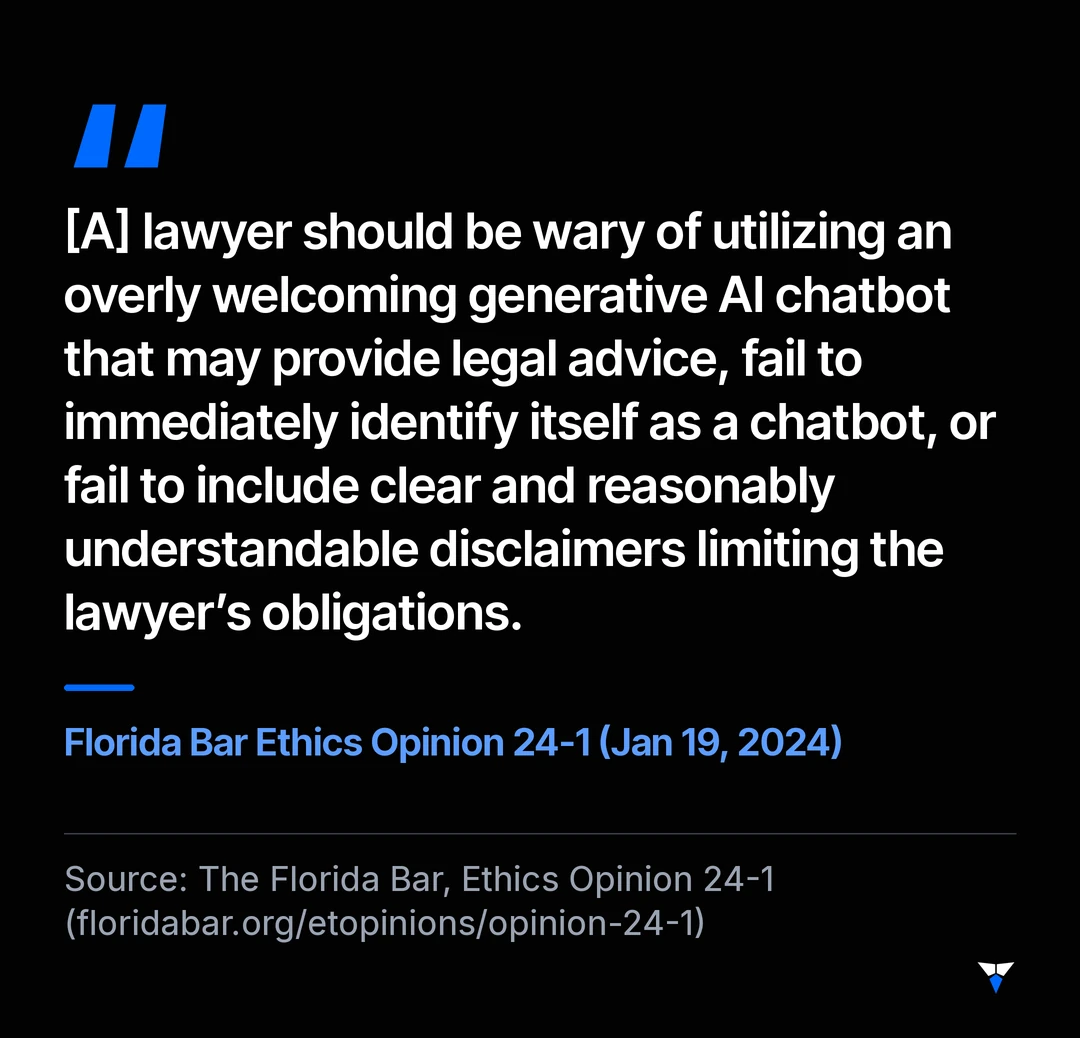
Yes. Opinion 24-1 says a chatbot that talks to prospective clients must tell them they are talking to an AI program, not a lawyer or law firm employee. It should not give legal advice, and Florida suggests screening questions for people who already have a lawyer. The Bar also warns about an “overly welcoming” chatbot: it can create a prospective-client or even a lawyer-client relationship without you knowing. You are responsible for anything it says.
The same up-front “I’m an AI” habit applies to phone bots.
How should Florida lawyers bill for AI-assisted work?
Efficiency cannot turn into inflated hours. Under Opinion 24-1:
- No double-billing or falsely inflated hours.
- You may charge reasonable time for case-specific research and drafting with AI, but not time spent developing minimal competence with the tool.
- Tell clients, preferably in writing, if you intend to charge the actual cost of an AI tool. If you cannot determine the cost for a particular matter, treat it as overhead.
- Florida suggests considering contingent fee arrangements or flat rates for specific services, so the time saved benefits you and the client.
ABA Opinion 512 says much the same: bill for time spent inputting and reviewing, but in most cases not for learning the tool. California’s 2026 guidance treats general AI subscriptions as overhead.
Can you use an AI notetaker on client calls?
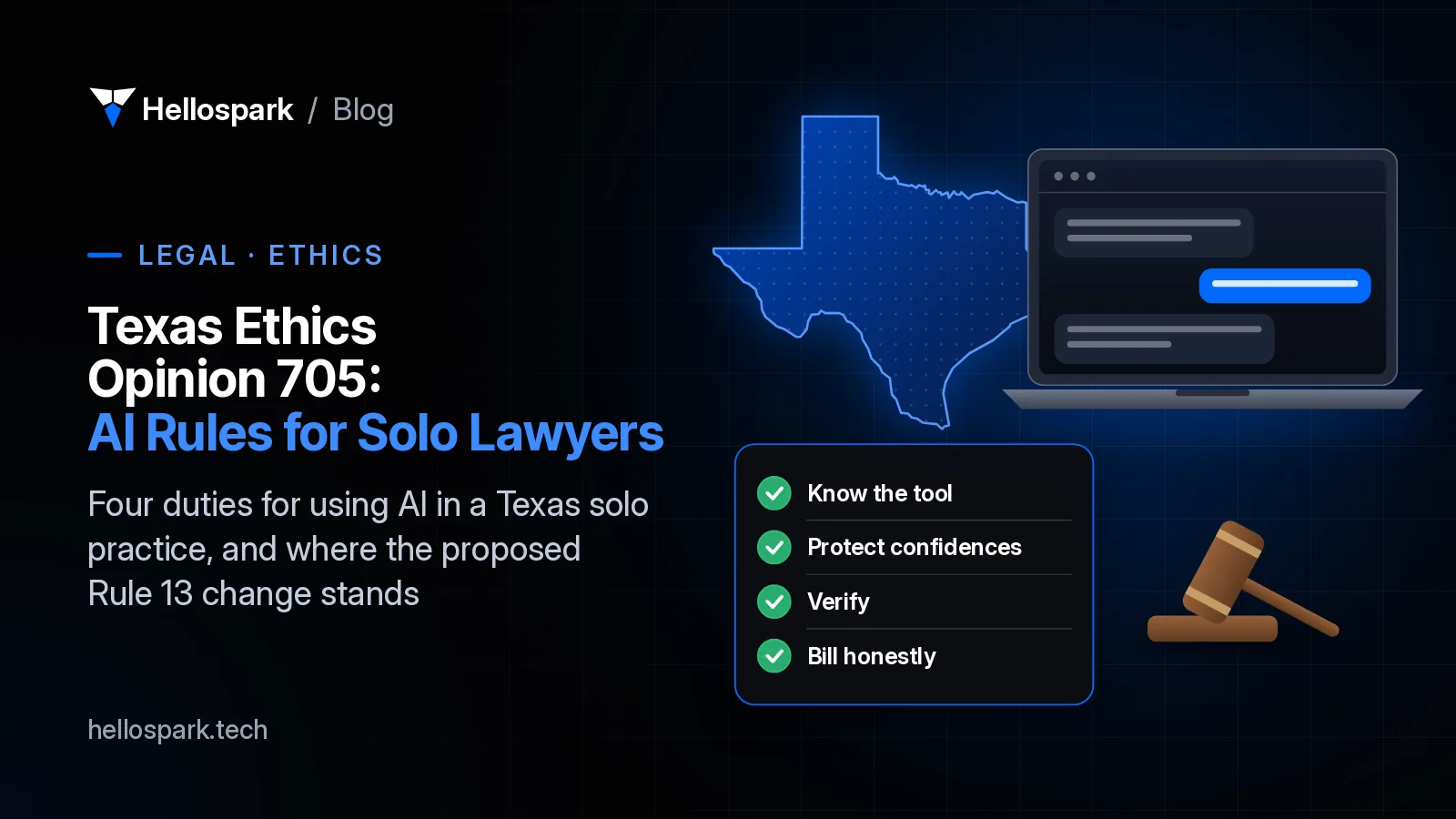
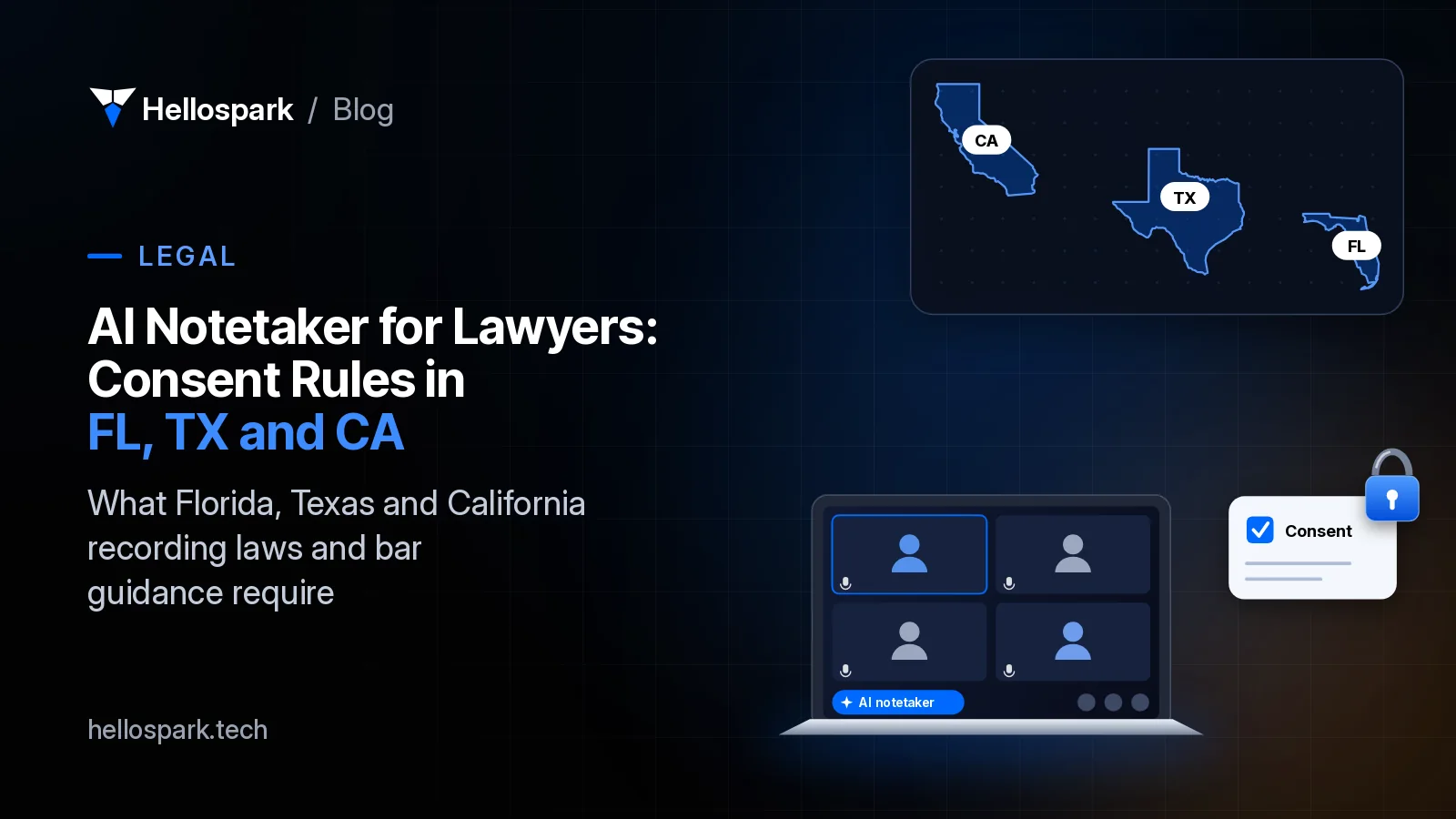
Yes, with care. Florida’s statute makes interception lawful when all of the parties have given prior consent (section 934.03(2)(d)), and Opinion 24-1’s confidentiality checks apply to where the audio and transcript are stored. AI recording tools are the second topic on the Bar’s December 10 list. For the full consent rules in Florida, Texas and California, see our AI notetaker for lawyers guide. If you also practice in Texas, see our Texas Ethics Opinion 705 guide. For California, see our California State Bar AI guidance and SB 574 checklist.
What about AI agents?
Florida hasn’t issued guidance on agents yet; agentic AI is the first topic on the December 10 list. California’s 2026 guidance already says a lawyer must review anything an agent sends out. Our house rule: the AI may draft, sort and summarize; a lawyer approves anything that leaves the office.
Does Florida require AI CLE?
Not AI specifically. Every Florida Bar member needs 30 CLE hours every three years, with at least 3 in approved technology programs (Rule 6-10). An AI course counts toward those hours only if it’s approved for technology credit, so check the credit type before you sign up.
What is the Florida Bar changing? (Dec 10, 2026 meeting)
On October 15, 2026, the Bar announced that, following an inquiry by its Special Committee on Artificial Intelligence (AI) Tools and Resources, the Board Review Committee on Professional Ethics will consider a proposed advisory opinion at the Board of Governors’ direction. The meeting is Thursday, December 10, 2026, 1–3 p.m., at the Omni Amelia Island. That is a meeting date, not a deadline for lawyers, and there were no drafts at the time. The opinion may cover:
- Lawyers’ use of agentic AI tools.
- AI tools that record, transcribe and summarize communications.
- Guidance to clients about their own use of AI tools.
- Updates to Opinion 24-1.
Members may comment. Comments must say they concern proposed ethics guidance for AI, and may suggest additional fee arrangements for the opinion to address. Email eto@floridabar.org or write to Ethics Counsel Jonathan Grabb; comments must be postmarked by December 1. We’ll update this section after the meeting.
How do you set up AI safely in a solo practice?
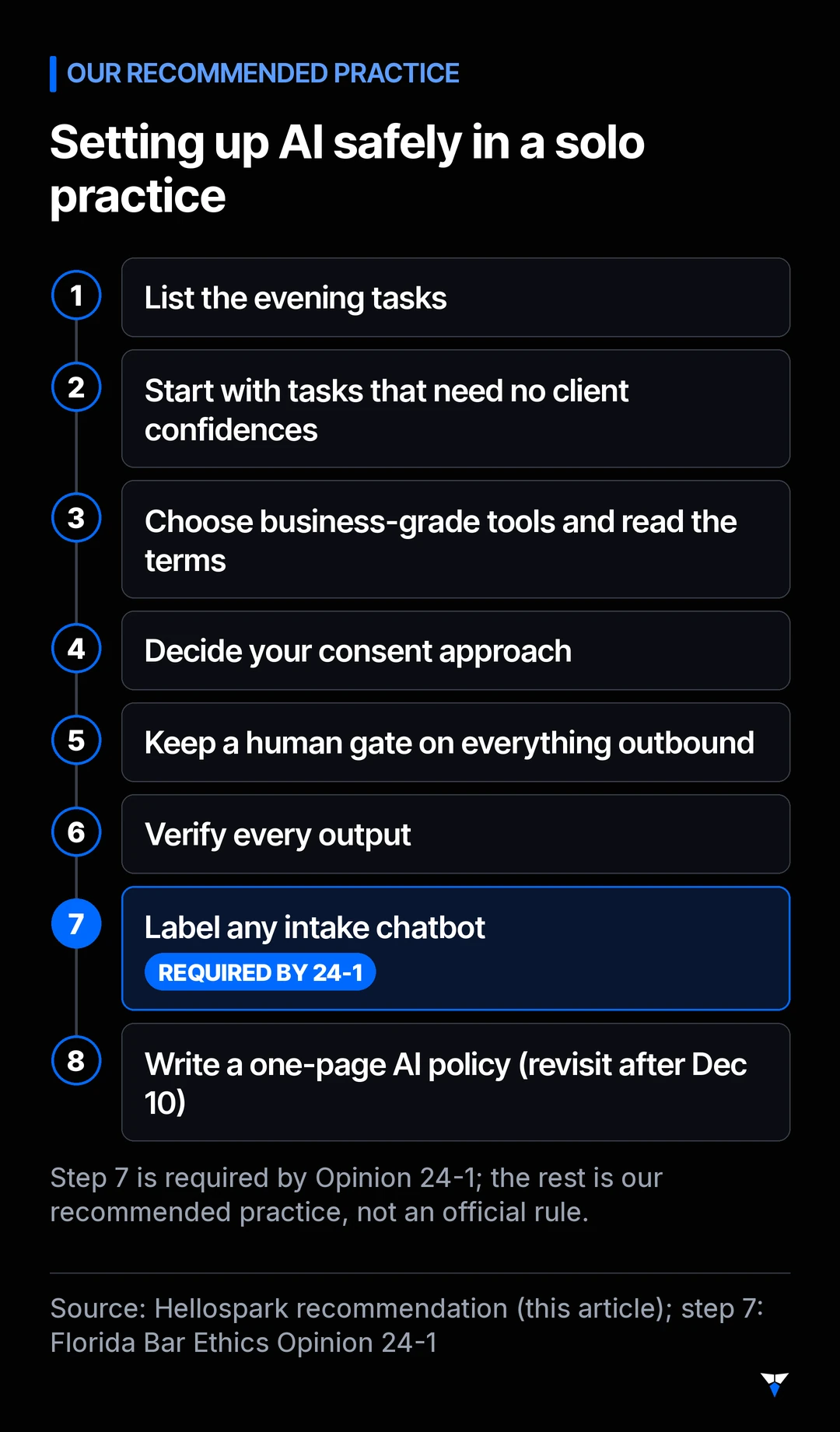
- List the evening tasks. Email triage, call notes, scheduling, intake, first drafts of routine letters.
- Start with tasks that need no client confidences. Marketing copy, generic checklists, your own templates, summaries of public rules you will verify.
- Choose business-grade tools and read the terms. Look for settings that keep your data out of model training, clear retention rules and two-factor sign-in.
- Decide your consent approach. Explain in your engagement letter, in plain words, how you use AI and protect client information.
- Keep a human gate on everything outbound. Set tools to draft, not send.
- Verify every output. Read every citation in the original source. Check names, dates and numbers against the file.
- Label any intake chatbot. It must say it is an AI program, not a lawyer or employee.
- Write a one-page AI policy. Approved tools, what may go into them, who reviews outputs and how you bill. Revisit it after December 10.
Done this way, the AI handles the first draft and the sorting, you keep the judgment, and the evening admin shrinks.
Where to go from here
The rules are not asking lawyers to avoid AI. They are asking you to stay in charge of it. That is a setup problem more than a legal one: the right tools, the right settings, drafts instead of auto-send, and a short written policy.
That is what we do in a 1-hour, 1:1 AI setup session ($100): we set the tools up with you, in your own accounts, and you leave with a written plan. Not sure it fits your practice? Book the free 15-minute fit call first, or see what we set up for lawyers and accountants. For background, read What is an AI agent, and when does your business actually need one?.
Sources
- The Florida Bar, Proposed advisory opinion on Artificial Intelligence tools (October 15, 2026)
- The Florida Bar, Ethics Opinion 24-1 and full text (PDF) (January 19, 2024)
- The Florida Bar, Frequently Asked Questions About CLE Requirements
- American Bar Association, ABA issues first ethics guidance on a lawyer’s use of AI tools (July 29, 2024), on Formal Opinion 512
- The State Bar of California, Ethics & Technology Resources (approval of updated guidance on May 14, 2026) and Practical Guidance for the Use of Generative Artificial Intelligence in the Practice of Law (2026)
- Florida Statutes, Section 934.03, Interception and disclosure of wire, oral, or electronic communications prohibited
Frequently asked questions
What are the Florida Bar's rules on lawyers using AI?
Florida Ethics Opinion 24-1 (January 19, 2024) says lawyers may use generative AI but must protect client confidentiality, verify the work, avoid improper billing such as double-billing, and follow the advertising rules. Any chatbot that talks to clients or prospects must say it is an AI program, not a lawyer or employee. Advisory opinions are not binding, but they explain how the Rules Regulating The Florida Bar apply.
Does a Florida lawyer need client consent before using AI?
Not always. Opinion 24-1 recommends getting the client's informed consent before using a third-party AI tool in a way that would disclose confidential information. If no confidential information goes to a third party, Rule 4-1.6 does not require informed consent. Either way, check the tool's data retention, data sharing and self-learning policies first.
Does a law firm chatbot in Florida have to say it's AI?
Yes. Opinion 24-1 says prospective clients must be told they are communicating with an AI program, not a lawyer or law firm employee. The chatbot should not give legal advice, and Florida suggests screening questions for people who already have a lawyer. The lawyer is responsible for what it says.
Is the new Florida Bar AI opinion already in force?
No. On October 15, 2026, The Florida Bar said its Board Review Committee on Professional Ethics will consider a proposed advisory opinion at a meeting on December 10, 2026, and that there were no drafts yet. Until something new is adopted, Opinion 24-1 is the Florida guidance on generative AI.
Which Florida Bar committee is working on AI?
The proposed opinion follows an inquiry by the Bar's Special Committee on Artificial Intelligence (AI) Tools and Resources. At the Board of Governors' direction, the Board Review Committee on Professional Ethics will consider it on December 10, 2026. Member comments must be postmarked by December 1.
Can a Florida lawyer bill for time saved with AI?
Not as if the work were done by hand. Opinion 24-1 bars double-billing and inflated hours. You may bill reasonable time spent on case-specific research and drafting with AI, but not time spent developing minimal competence with the tool. Florida suggests considering contingent fees or flat rates for specific services, so that both you and the client benefit from the time saved.
Can I use an AI notetaker on client calls in Florida?
It is one of the topics the Bar's December 10, 2026 meeting may address. Two things already apply. Your duty of confidentiality means checking where the recording and transcript are stored. Florida's statute makes interception lawful when all parties have given prior consent. Tell everyone on the call, ask first, and note their agreement. Our AI notetaker guide covers the consent rules in Florida, Texas and California.
Does Florida require AI CLE?
Not AI specifically. Every Florida Bar member must complete 30 CLE hours every three years, including at least 3 hours in approved technology programs. An AI course counts toward the technology hours only if it is approved for technology credit.

Written by Ayoub El Mardi
Co-founder, Spark Tech
Ayoub co-founded Spark Tech, an AI and automation consultancy in Marrakech, and works directly with every client from the first call to handover.
Want AI set up for your work?
One 1:1 video hour with a founder to set up AI for your admin. $100, paid when you book.
Get plain-English AI tips for your business
Simple guides to using AI for your admin, written by the two founders. No spam; about one email a month.