Texas Ethics Opinion 705: AI Rules for Solo Lawyers
What Texas Ethics Opinion 705 means for solo lawyers using AI: four duties, billing, and why the Rule 13 AI filing change still isn't final.

Ayoub El Mardi · Co-founder, Spark Tech
13 min read · · Updated
Last updated
Updated : updated the Rule 13 status after the expected October 1, 2026 date passed with no final order, and added FAQs on newer Texas AI opinions, whether Opinion 705 is binding, and N.D. Tex. AI disclosure.
Earlier updates (2)
- : named Hellospark in the intro disclaimer (brand rule).
- : named Spark Tech in the intro disclaimer.
Disclaimer. This article is general information about technology for law practices. It is not legal or ethics advice. Hellospark is a technology consultancy, not a law firm. Ethics opinions and court rules change: read the current texts, and check specific questions with the State Bar of Texas Ethics Helpline or a qualified ethics lawyer.
In this article · 9 sections
- What is Texas Ethics Opinion 705?
- What does Texas Ethics Opinion 705 require from a solo lawyer?
- Can a Texas lawyer put client information into ChatGPT?
- Can Texas lawyers bill for time AI saved?
- What is the Texas Supreme Court’s proposed AI rule for filings?
- How many Texas lawyers already use AI?
- How do you set up AI in a Texas solo practice?
- Where to go from here
- Sources
- Frequently asked questions
If you run a solo practice in Texas, your evenings probably go to the same things: drafting the demand letter, cleaning up the engagement letter, answering the client email you didn’t get to at 3 p.m. Generative AI can take a real chunk of that off your plate, which is how you get your evenings back.
The question that holds lawyers back is the ethics. In the State Bar of Texas’s 2026 AI in the Practice of Law Survey, respondents who don’t use AI “cited ethical concerns (59%) as the primary reason.” The good news is that Texas has a clear starting point: Texas Ethics Opinion 705 (from the Professional Ethics Committee for the State Bar of Texas). This guide explains what it says, what the Supreme Court of Texas is changing for court filings, and how to set up AI in a solo practice without crossing a line.
Hellospark, a small AI consultancy for US solo professionals, explains what the official texts say and how the tools work. We are not a law firm. The ethics calls are yours.
What is Texas Ethics Opinion 705?
- Opinion 705 (often called Texas Bar Opinion 705)
- An opinion of the Professional Ethics Committee for the State Bar of Texas, dated February 2025, answering one question: "What ethical issues are raised under the Texas Disciplinary Rules of Professional Conduct by a lawyer's use of generative artificial intelligence in the practice of law?" It was issued at the request of the State Bar's Taskforce on Responsible AI in the Law. Read it at the Texas Center for Legal Ethics.
- Rule 1.01 (competence)
- The Texas rule on competent and diligent representation. Comment 8 says lawyers "should strive to become and remain proficient and competent in the practice of law, including the benefits and risks associated with relevant technology."
- Rule 1.05 (confidentiality)
- The Texas rule on client confidential information. Opinion 705 notes that the duty covers both privileged information and all other information relating to a client or furnished by the client during the representation.
- Rule 5.03 (nonlawyer assistants)
- The Texas rule on supervising nonlawyer assistants. Opinion 705 compares relying on AI to relying on "inexperienced or overconfident nonlawyer assistants."
Texas numbers its rules differently from the ABA Model Rules (the ABA’s competence rule is 1.1, Texas’s is 1.01), so search for the Texas numbers when you look things up.
Opinion 705 calls itself “a snapshot of potential ethical concerns at the moment and a restatement of certain ethical principles for lawyers to use as a guide regardless of where the technology goes.” It applies existing rules to AI. It doesn’t create a separate AI rule.
Is there anything newer? As of November 2, 2026, no. The committee’s later opinions (706 to 710) cover other topics, and none of the three proposed opinions it has open for comment until December 20, 2026 is about AI. Committee opinions guide Texas lawyers but, by statute, “are not binding on the supreme court” (Tex. Gov’t Code § 81.092(c)).
What does Texas Ethics Opinion 705 require from a solo lawyer?
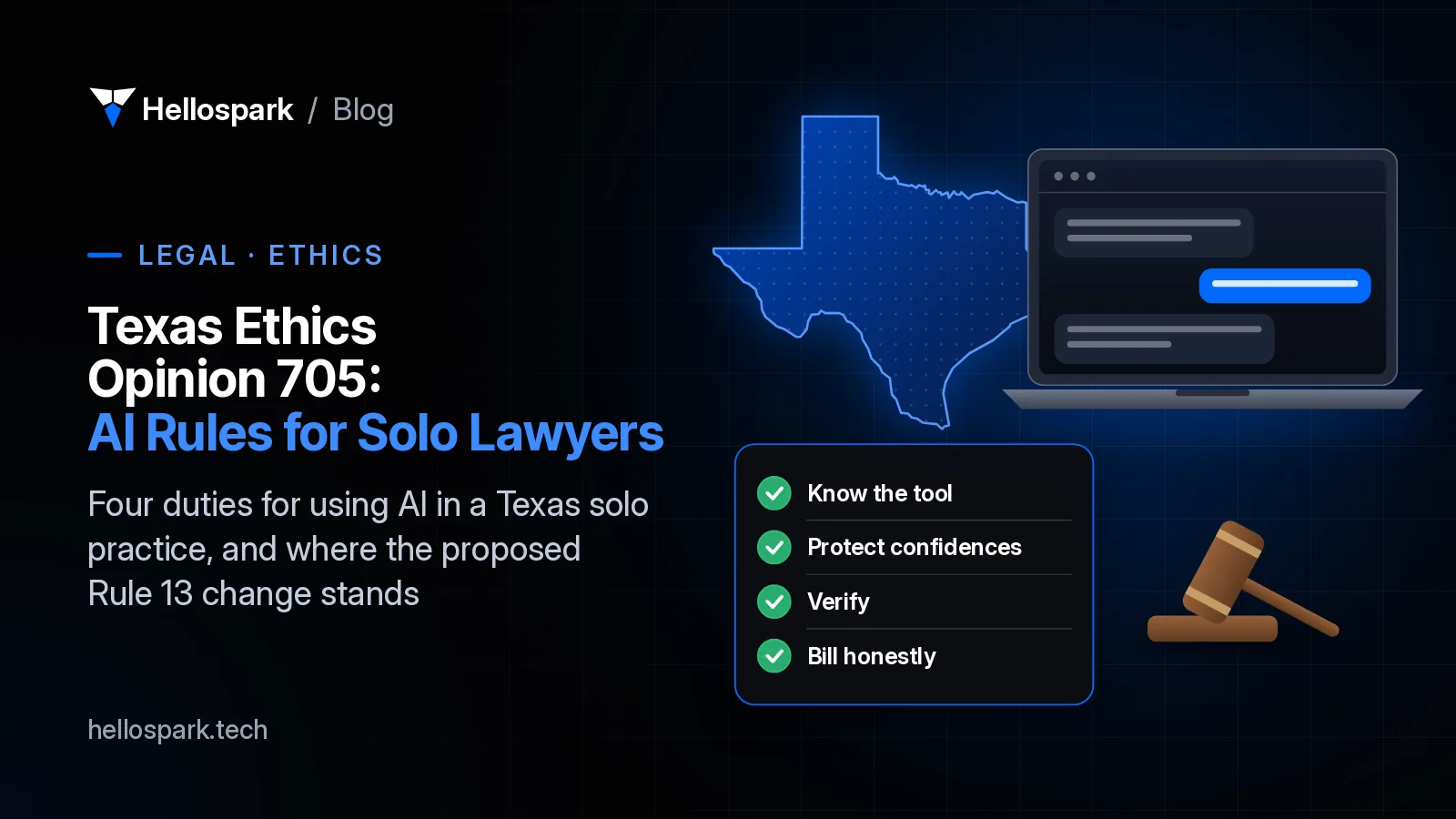
The opinion’s conclusion boils it down to four duties. Here they are with the rule each one comes from, in the opinion’s words, and what it means day to day.
| Duty | Texas rule | What Opinion 705 says | In practice (our reading) |
|---|---|---|---|
| Know the tool | 1.01 | If a lawyer opts to use generative AI, the lawyer “must have a reasonable and current understanding of the technology” | Learn how your tool stores and uses what you type before client work goes in |
| Protect confidences | 1.05 | The lawyer “should be reasonably satisfied that the program will not reveal confidential information to others” | Use a plan with written data terms, and keep client facts out of tools you haven’t vetted |
| Verify everything | 1.01, 3.01, 3.03, 3.04, 5.03 | “Lawyers are responsible for the work product they submit regardless of who (or what) does the original research and drafting” | Check every citation, quote and fact before anything leaves your office |
| Bill honestly | Fees (see Opinion 594 on expenses) | A lawyer “may not, however, charge hourly fees for the time that was ‘saved’ by using the generative AI program” | Bill the time you actually spent, including prompting and checking |
The opinion also says Rule 1.01 “almost certainly does not require the use of generative AI for any particular purpose,” while quoting an earlier opinion that lawyers should not “unnecessarily retreat[] from the use of new technology that may save significant time and money for clients.”
Can a Texas lawyer put client information into ChatGPT?
It depends on the tool and how you use it. Opinion 705 says there may be ways to use some AI programs for general research without revealing client confidential information. But a draft demand letter or settlement agreement would require feeding the tool confidential facts, and “in any case where the lawyer intends to provide client confidential information to the program, Rule 1.05 will likely be implicated.”
The opinion’s main worry is “self-learning” programs that store user inputs to refine responses, because confidential information “may be stored within the program and revealed in responses to future inquiries by third parties. That is obviously unacceptable.” Its test:
- The lawyer “should be reasonably satisfied that the program will not reveal confidential information to others or permit the use of such information to the disadvantage of the client.”
- If not, the lawyer “should—at a minimum—not input any confidential information to the program without client consultation and consent.”
Drawing on its earlier cloud-computing Opinion 680, the committee lists reasonable precautions:
- Acquiring a general understanding of how the technology works.
- Reviewing and potentially renegotiating the “terms of service” for the tool.
- Learning about the tool’s data-security protections, because even a tool that doesn’t share inputs “may be particularly vulnerable to hacking of stored information.”
- Training lawyers and staff to use AI tools while protecting client confidential information.
What about telling clients? The opinion says a lawyer who intends to use confidential information with AI “should consider informing clients about the associated risks and may need to secure client consent.” It notes that the ABA (Formal Opinion 512) and the Florida Bar (Opinion 24-1) “go a step further and suggest that lawyers should obtain informed consent.” If you also practice in Florida, our guide to the Florida Bar’s AI rules covers that standard.
Can Texas lawyers bill for time AI saved?
No. In most hourly arrangements, the opinion says a lawyer “will likely be able to charge the client for the actual time the lawyer spends using a generative AI program,” including time to refine the outputs and check the work. What you can’t do is bill the hours the tool saved you.
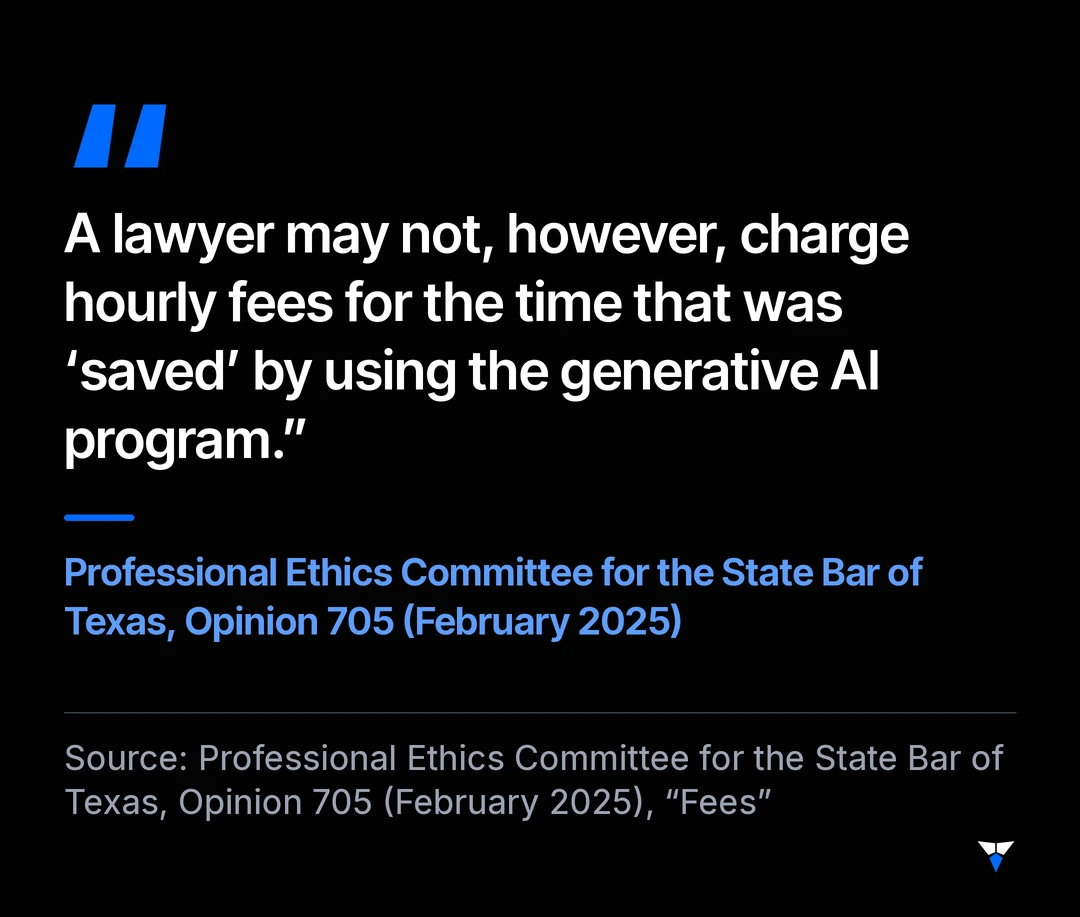
Per-use AI fees are different. If you pay per use, the opinion says you “may be able to collect those expenses from the client, as allowed by law and if the client accepts that arrangement,” much like Westlaw or LexisNexis charges. But Opinion 705 adds: “The lawyer will generally not be permitted to recover more than the amount of expenses actually incurred and paid to the generative AI provider.”
What is the Texas Supreme Court’s proposed AI rule for filings?
On June 26, 2026, the Supreme Court of Texas issued Misc. Docket No. 26-9054, a preliminary approval of amendments to Texas Rule of Civil Procedure 13 and Texas Rules of Appellate Procedure 9 and 52, plus the repeal of Rule 57. Under proposed Rule 13(c)(1), by signing a court filing, the signer represents to the court that “the signer reviewed the filing and verified its accuracy, including that the legal citations, quotations, and holdings are not fabricated.”
The proposed comment says the rule “is adopted principally to address concerns about the improper use of artificial intelligence in filings” and that verifying a filing for accuracy is important “regardless of whether artificial intelligence was used.” Nothing in the proposed text requires you to disclose AI use (our reading of the order). Proposed sanctions “may include reprimand, contempt, striking of the filing in whole or in part, dismissal of proceedings, costs, or attorney’s fees,” and must be proportionate to the violation found.
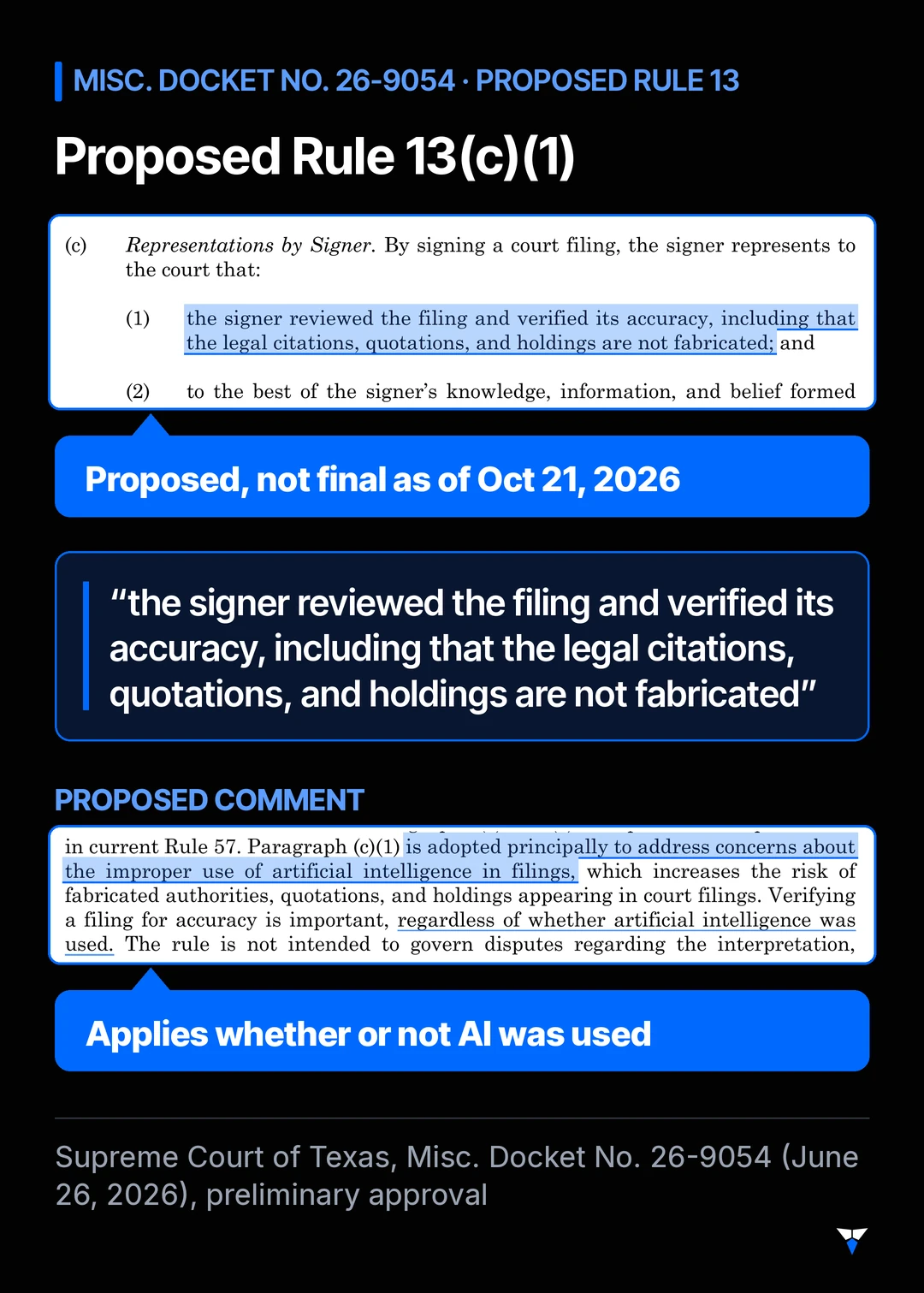
Is it in effect? Not yet, as far as the posted orders show. The order said comments were due by September 1, 2026, that the Court “will issue an order finalizing the amendments after the close of the comment period” and “may change the amendments in response to public comments,” and that it “expects the amendments to take effect on October 1, 2026.” That date has passed. When we checked the Court’s rules orders page on November 2, 2026, Misc. Docket No. 26-9054 was still listed only as a preliminary approval, and the newest rules orders (October 2, 2026) covered other rules. Check that page before you rely on the new wording, and either way, verify your citations: Opinion 705 already says “lawyers cannot blindly rely upon or use answers given by generative AI tools.”
Opinion 705 also reminds lawyers to check how each court treats AI. In the Northern District of Texas, Local Civil Rule 7.2(f) says a brief prepared using generative AI “must disclose this fact on the first page under the heading ‘Use of Generative Artificial Intelligence,’” and a brief filed without that disclosure certifies that no part of it was prepared using generative AI. The Fifth Circuit, by contrast, declined on June 10, 2024 to adopt a special AI rule. California is going further: its new statute requires lawyers to disclose AI use to the court from January 1, 2027.
How many Texas lawyers already use AI?
More than half of respondents, and solos are catching up fast. The State Bar of Texas’s 2026 AI in the Practice of Law Survey (1,553 respondents, margin of error ±2%) found that AI use rose from 30% in 2024 to 62% in 2026. Among private practitioners, solo practitioners “remained the lowest adopters at 54%,” up from 20% in 2024.
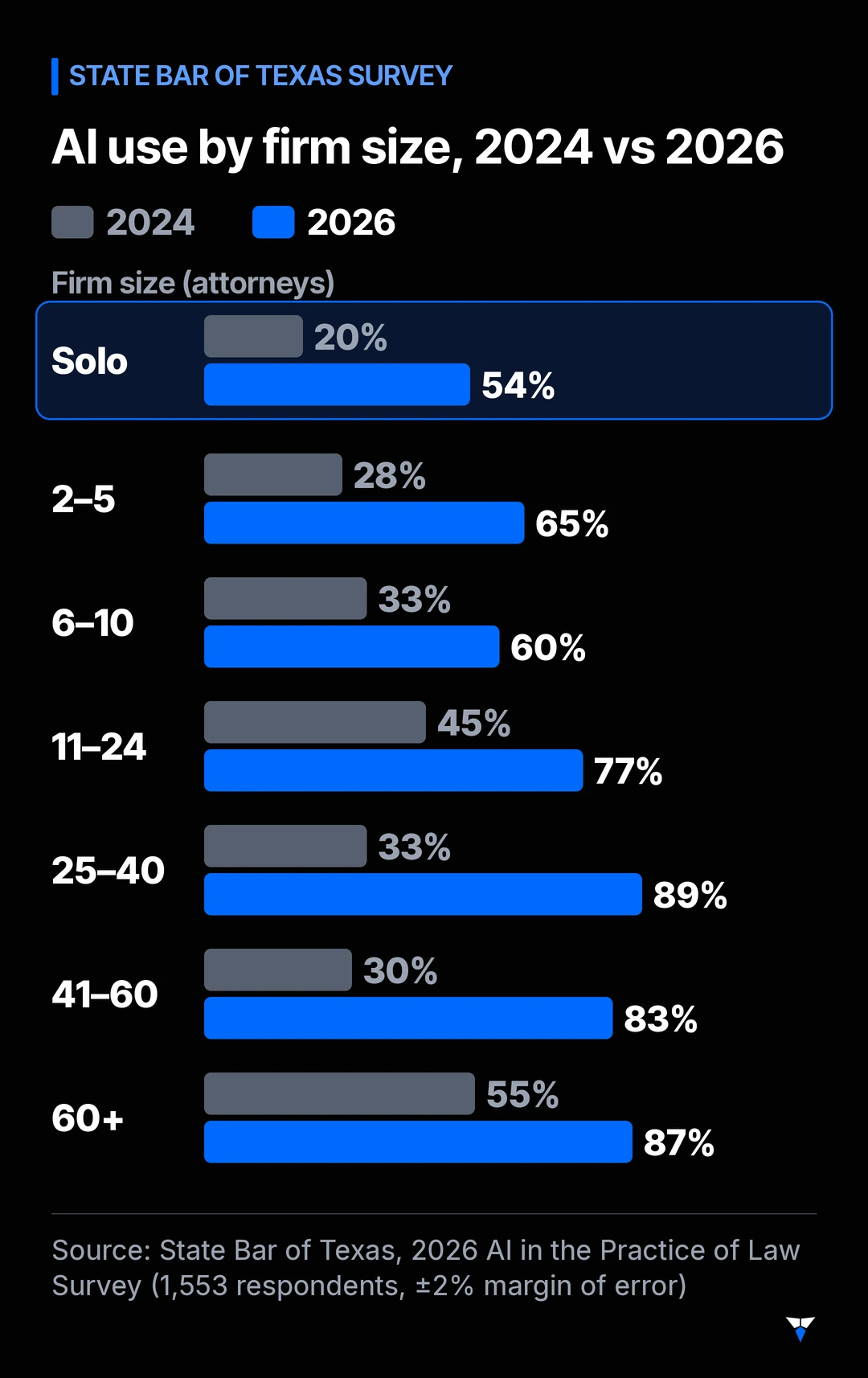
The same survey found that 50% of respondents report their firm has no official AI policy. For a solo, you are the firm, so writing a one-page policy for yourself is a quick win (step 2 below).
How do you set up AI in a Texas solo practice?
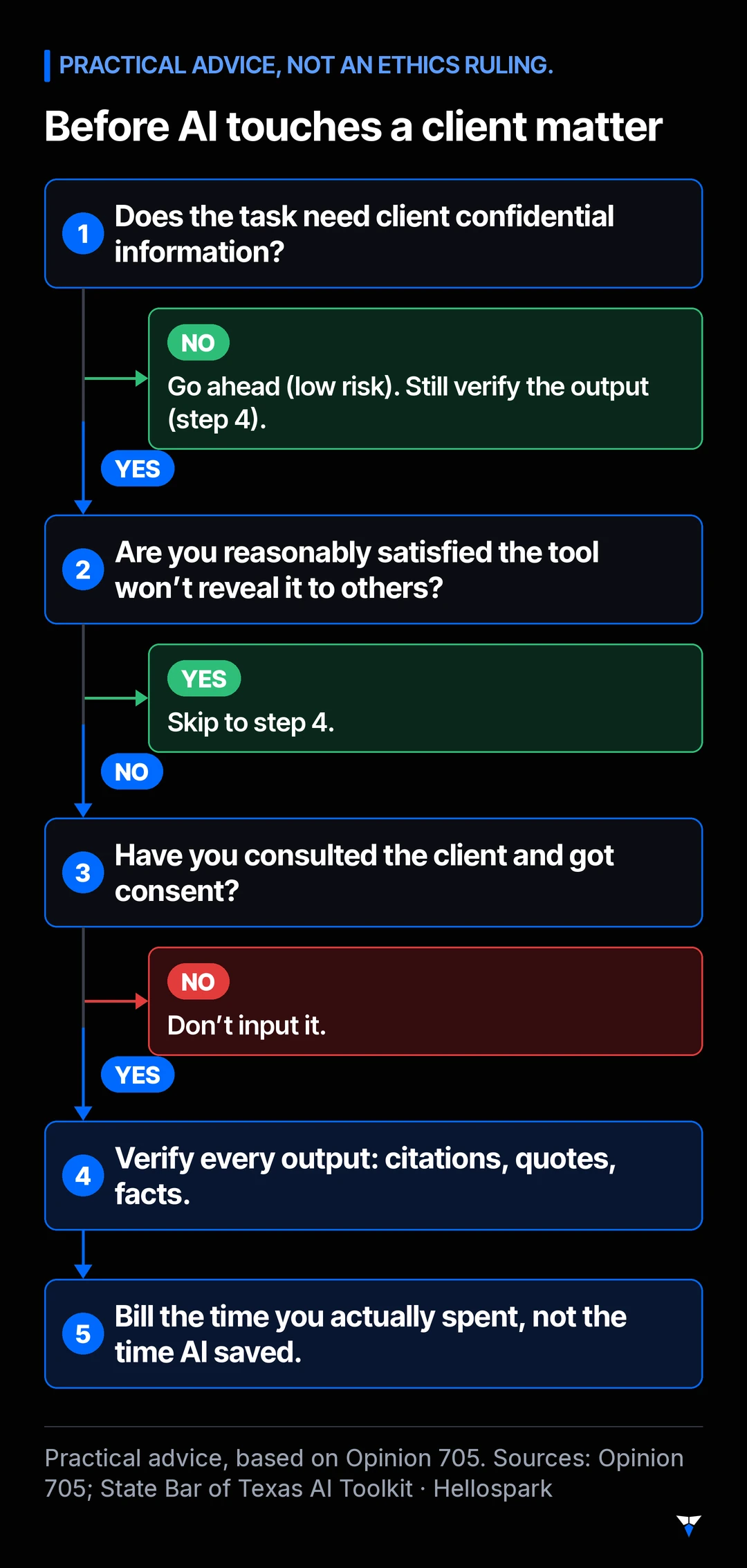
This is the order we follow when we set up AI with a solo lawyer. It’s practical advice built on Opinion 705 and the State Bar of Texas’s Texas Bar AI Toolkit, not an ethics ruling.
- Sort your tasks by risk. The toolkit’s risk table puts general admin like scheduling (without sensitive case details) at “Least Risk” and research and document drafting at “High Risk,” where independent human verification is required. Start with the low-risk work. If a tool would act on its own, like sending emails for you, read when an AI agent is the wrong choice first.
- Write a short AI policy. The toolkit says internal policies should clearly define permitted AI tools and use cases, and explicitly prohibit risky practices such as entering confidential data into unsecured platforms. It offers a sample acceptable use policy.
- Pick a paid plan with written data terms. The toolkit’s data-security example uses “a paid, enterprise account from a leading, reputable vendor” and gets “a written agreement from the vendor specifying the data security and privacy terms.” Read the terms of service, as Opinion 705 suggests, and check whether your inputs are used for training.
- Add an AI clause to your engagement letter. The State Bar’s sample AI disclosures include, for example: “The Firm may use AI tools to assist with tasks such as legal research, document review, and drafting. These tools are used under attorney supervision to improve efficiency and quality.” Tailor it, and get consent where Opinion 705 says you may need it.
- Strip what the task doesn’t need. The toolkit suggests removing or anonymizing sensitive client identifiers where feasible before processing documents through AI.
- Verify every output. Opinion 705 says AI output “can be used as a starting point for a lawyer’s work, but must always be carefully analyzed for accuracy and quality.” Pull and read every case the tool cites.
- Bill actual time. Record the time you spent prompting and checking, not the time the task “would have” taken. Agree on any per-use AI expenses with the client in writing.
- Label your website chatbot. If you use one, the State Bar’s sample chatbot disclaimer tells visitors it is “for informational purposes only,” doesn’t create an attorney-client relationship, and that they should not submit confidential or sensitive information.
If you’ll use an AI notetaker on client calls, read our guide to AI notetaker consent rules in Florida, Texas and California first.
If you also practice in California, our California State Bar AI guidance and SB 574 checklist covers the new statutory duties that start January 1, 2027.
Where to go from here
Opinion 705 isn’t a reason to stay away from AI. It’s a checklist: know the tool, guard the client’s information, check the work and bill honestly. Most of that is set up once and then becomes habit.
Picking the right plan, turning off training on your data, adding the engagement-letter clause and building a few reusable prompts for letters and client emails is exactly what we do in a 1-hour, 1:1 AI setup session ($100). We do it with you on video, in your own accounts, and you leave with a written plan. Not sure it fits your practice? Book the free 15-minute fit call first. You can also see what we set up for lawyers.
Sources
- Professional Ethics Committee for the State Bar of Texas, Opinion 705 (February 2025); PDF
- Joshua Weaver, Ethics opinion offers principles for lawyers’ ethical use of AI, Texas Bar Blog (April 1, 2025)
- Texas Center for Legal Ethics, Ethics Opinions index (checked November 2, 2026)
- State Bar of Texas, Proposed ethics opinions open for public comment (checked November 2, 2026)
- U.S. District Court for the Northern District of Texas, Local Civil Rule 7.2, Briefs, LR 7.2(f) (checked November 2, 2026)
- Supreme Court of Texas, Misc. Docket No. 26-9054, Preliminary Approval of Amendments to Texas Rule of Civil Procedure 13 and Texas Rules of Appellate Procedure 9 and 52 (June 26, 2026)
- Supreme Court of Texas, Administrative Orders: Rules Advisories (checked November 2, 2026)
- State Bar of Texas, 2026 AI in the Practice of Law Survey (released June 18, 2026)
- State Bar of Texas, Texas attorneys’ AI use more than doubled since 2024 (Texas Bar Blog, June 2026)
- State Bar of Texas Law Practice Management, Artificial Intelligence Toolkit (checked November 2, 2026)
- State Bar of Texas, Sample AI Disclosures for Attorney-Client Contracts (2025)
- State Bar of Texas, Sample Chatbot Disclaimer for Law Firm (2025)
- State Bar of Texas, Law Firm Acceptable Use Policy for Artificial Intelligence (2025)
Frequently asked questions
What does Texas Ethics Opinion 705 say about AI?
Opinion 705, from the Professional Ethics Committee for the State Bar of Texas (February 2025), concludes that lawyers "should acquire basic technological competence before using any generative AI tool, should always ensure that the tool does not imperil confidential client information, should always verify the accuracy of any responses received from a generative AI tool, and should not charge clients for the time 'saved' by using a generative AI program."
Can a Texas lawyer put client information into ChatGPT?
Only with care. Opinion 705 says the lawyer should be reasonably satisfied that the program will not reveal confidential information to others or permit its use to the client's disadvantage. If the lawyer is not so satisfied, the lawyer should, at a minimum, not input any confidential information without client consultation and consent. It also says lawyers should consider informing clients about the risks and may need to secure client consent.
Can Texas lawyers bill for time saved by AI?
No. Opinion 705 says a lawyer billing hourly will likely be able to charge for the actual time spent using the AI tool, including refining and checking its output, but "may not, however, charge hourly fees for the time that was 'saved' by using the generative AI program." Per-use AI costs may be passed on if allowed by law and the client accepts that arrangement, generally at no more than the amount actually paid.
Did the Texas Rule 13 AI verification rule take effect on October 1, 2026?
Not as far as the Supreme Court of Texas's posted orders show. Misc. Docket No. 26-9054 (June 26, 2026) preliminarily approved the change, said the Court would issue a finalizing order after comments closed on September 1, 2026, and said it expected the amendments to take effect on October 1, 2026. As of November 2, 2026, the Court's rules orders page still lists only that preliminary approval, and its newest rules orders (October 2, 2026) cover other rules. Treat the new wording as proposed, and check the page before relying on either version.
Do Texas lawyers have to disclose AI use to clients?
Opinion 705 does not set a blanket disclosure rule. It says lawyers who intend to use confidential information with generative AI should consider informing clients about the risks and may need to secure client consent. The State Bar of Texas toolkit offers sample AI disclosure clauses for engagement agreements that you can tailor.
Is there a newer Texas ethics opinion on AI than Opinion 705?
Not as of November 2, 2026. The Professional Ethics Committee's later opinions, 706 to 710, cover other topics, and its three proposed opinions open for comment until December 20, 2026 (PO 2026-1, 2026-2 and 2026-3) are not about AI either. Opinion 705 is still the committee's AI opinion.
Is Texas Ethics Opinion 705 binding?
Not on the courts. Texas ethics opinions are guidance from the Professional Ethics Committee, and Tex. Gov't Code § 81.092(c) says "Committee opinions are not binding on the supreme court." Opinion 705 applies the existing Texas Disciplinary Rules of Professional Conduct, which do bind Texas lawyers, so treat it as the State Bar's reading of duties you already have.
Do Texas courts require you to disclose AI use in filings?
Some do. In the Northern District of Texas, Local Civil Rule 7.2(f) says a brief prepared using generative AI must disclose that on its first page under the heading "Use of Generative Artificial Intelligence." The proposed state Rule 13 change has no disclosure duty; it requires verifying citations, quotations and holdings. Check each court's local rules and standing orders.

Written by Ayoub El Mardi
Co-founder, Spark Tech
Ayoub co-founded Spark Tech, an AI and automation consultancy in Marrakech, and works directly with every client from the first call to handover.
Want AI set up for your work?
One 1:1 video hour with a founder to set up AI for your admin. $100, paid when you book.
Get plain-English AI tips for your business
Simple guides to using AI for your admin, written by the two founders. No spam; about one email a month.