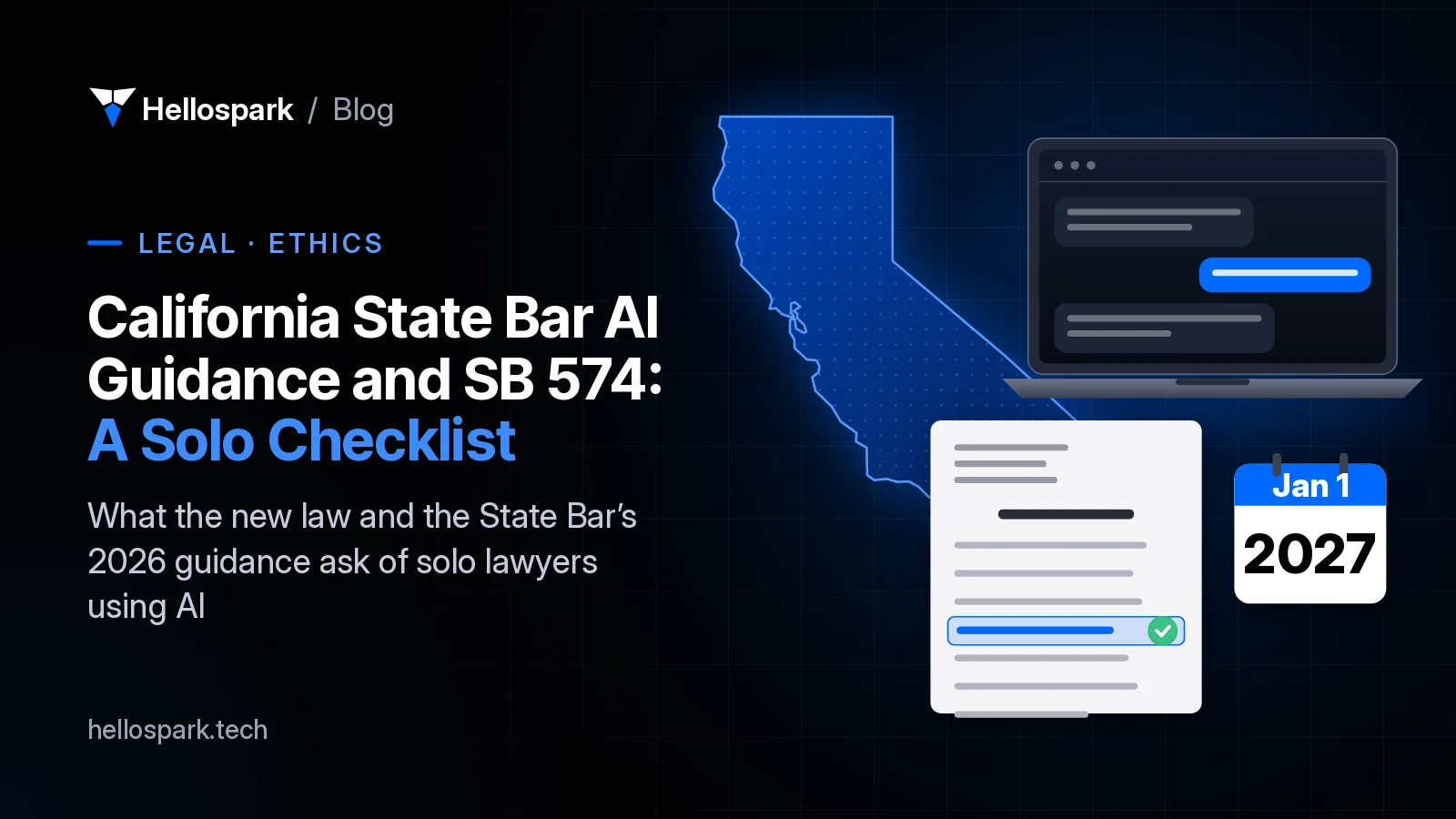
California State Bar AI Guidance and SB 574: A Solo Checklist
What the California State Bar AI guidance and the new SB 574 law mean for solo lawyers: confidentiality, citation checks, court disclosure, agents.

Ayoub El Mardi · Co-founder, Spark Tech
11 min read · · Updated
Last updated
Updated : named Hellospark in the intro disclaimer (brand rule).
Earlier updates (1)
- : named Spark Tech in the intro disclaimer.
Disclaimer. This article is general information about technology for law practices. It is not legal or ethics advice. Hellospark is a technology consultancy, not a law firm. Statutes, court rules and State Bar guidance change: read the current texts, and check specific questions with the State Bar of California's Ethics Hotline or qualified ethics counsel.
In this article · 8 sections
- What changed in California AI rules for lawyers in 2026?
- What does SB 574 require of California attorneys?
- What does the California State Bar AI guidance add?
- Can a California lawyer use an AI agent?
- How do SB 574 and the State Bar guidance compare?
- What should a California solo do before January 1, 2027?
- Where to go from here
- Sources
- Frequently asked questions
If you run a solo practice in California, your evenings probably go to the same pile: the client update email, the first draft of a demand letter, the meet-and-confer letter, the billing notes. Generative AI can take a good share of that off your plate. That’s how you get your evenings back.
But the ground rules just changed. Can California lawyers use AI? Yes. From January 1, 2027, a new statute, SB 574, makes four duties law: don’t hand the practice of law to AI, keep confidential and personal information out of AI tools that aren’t locked down, verify what the AI gives you (every citation especially), and tell the court when you used AI on a document you submit. The California State Bar AI guidance (its 2026 Practical Guidance) fills in the details, including AI agents and billing.
This guide puts the two side by side and ends with a checklist you can work through before January.
Hellospark, a small AI consultancy for US solo professionals, explains what the official texts say and how the tools work. We are not a law firm. The ethics and compliance calls are yours.
What changed in California AI rules for lawyers in 2026?
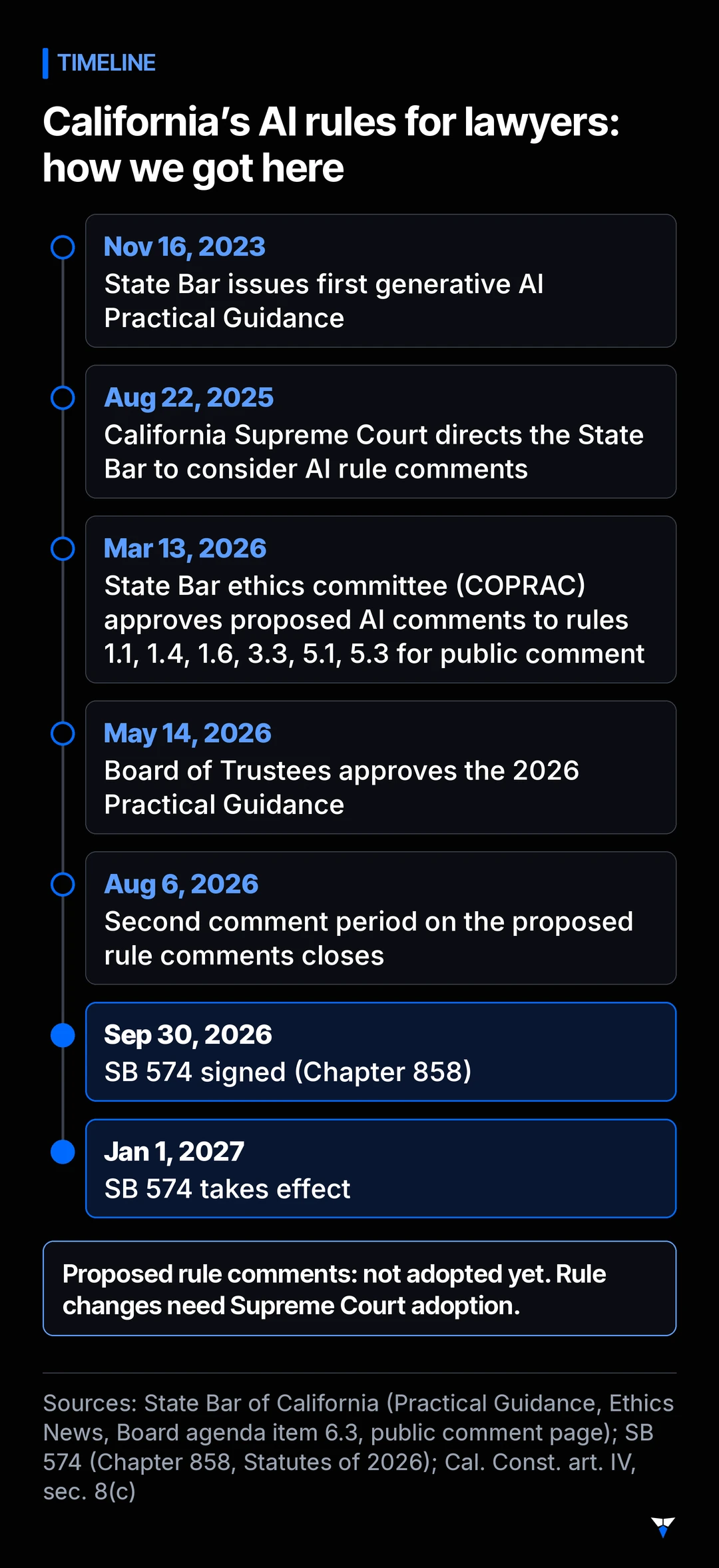
Three things, on three different tracks:
- SB 574 (a statute)
- Approved by the Governor on September 30, 2026, as Chapter 858, Statutes of 2026. It adds Business and Professions Code section 6068.1 on attorneys' use of generative AI, amends Code of Civil Procedure section 128.7 on citations in court filings, and adds rules for arbitrators.
- The 2026 Practical Guidance (State Bar guidance)
- On May 14, 2026, the State Bar's Board of Trustees approved updated revisions to the Practical Guidance for the Use of Generative Artificial Intelligence in the Practice of Law. It replaces the November 2023 version and, at the request of the California Supreme Court, addresses agentic AI.
- Proposed rule comments (not adopted yet)
- The State Bar's ethics committee (COPRAC) proposed AI-related comments to rules 1.1, 1.4, 1.6, 3.3, 5.1 and 5.3. The second public comment period closed on August 6, 2026. The Board's May 14 staff report says "the proposed changes are to the comments of the rules, rather than the text of the actual rules" and "Any rule changes would ultimately require Supreme Court adoption."
What does SB 574 require of California attorneys?
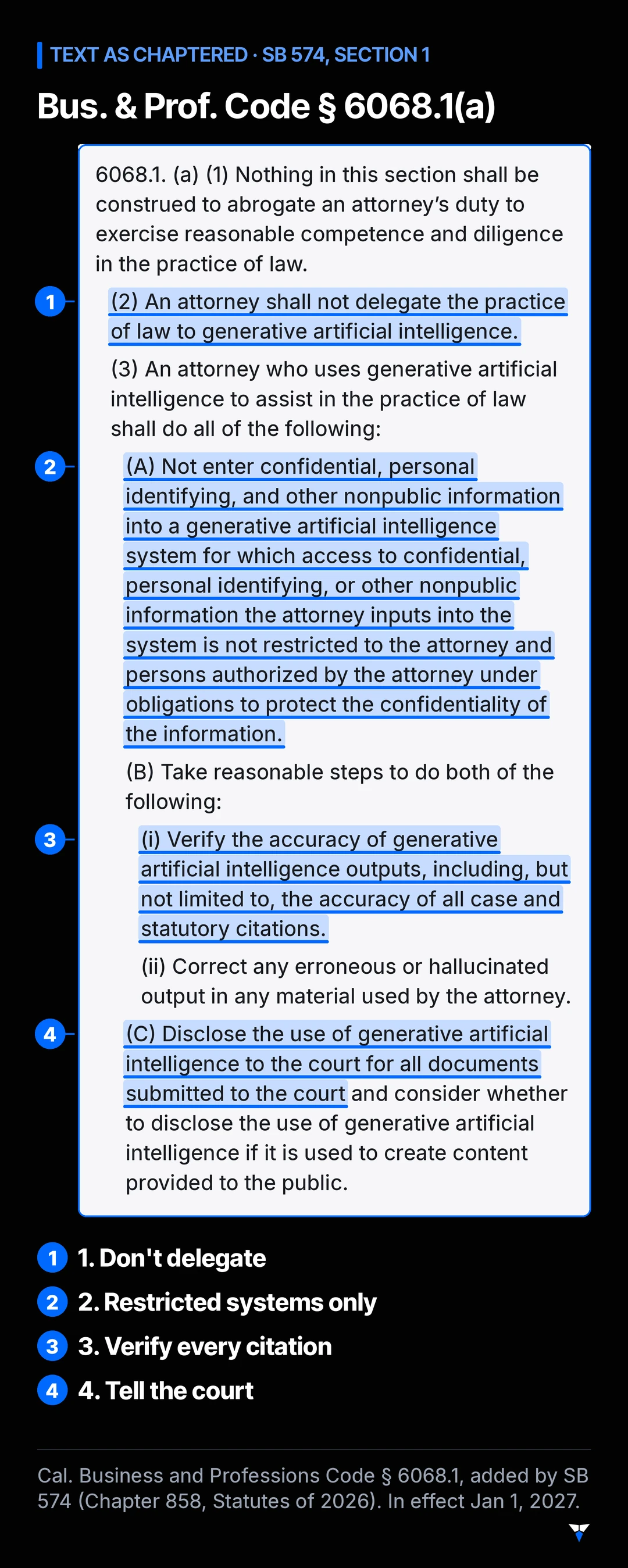
The new Business and Professions Code section 6068.1 starts by saying it doesn’t lower the bar: nothing in it abrogates “an attorney’s duty to exercise reasonable competence and diligence in the practice of law.” Then:
- “An attorney shall not delegate the practice of law to generative artificial intelligence.”
- An attorney who uses generative AI to assist in the practice of law must not enter “confidential, personal identifying, and other nonpublic information” into a generative AI system unless access to what the attorney enters “is restricted to the attorney and persons authorized by the attorney under obligations to protect the confidentiality of the information.”
- They must take reasonable steps to “verify the accuracy of generative artificial intelligence outputs, including, but not limited to, the accuracy of all case and statutory citations,” and to “correct any erroneous or hallucinated output in any material used by the attorney.”
- They must “disclose the use of generative artificial intelligence to the court for all documents submitted to the court and consider whether to disclose the use of generative artificial intelligence if it is used to create content provided to the public.”
The statute’s list of “personal identifying information” is worth reading before you paste anything. It includes driver’s license numbers; dates of birth; Social Security numbers; National Crime Information and Criminal Identification and Information numbers; addresses and phone numbers of parties, victims, witnesses and court personnel; medical or psychiatric information; financial information; account numbers; and “any other content sealed by court order or deemed confidential by court rule or statute.”
SB 574 also amends Code of Civil Procedure section 128.7, California’s sanctions statute for court papers. New paragraph (b)(2) says a brief, pleading, motion or other paper filed in any court “shall not contain any citations that an attorney responsible for submitting the pleading has not personally verified, including any citation provided by generative artificial intelligence.” Section 128.7(c) already lets a court sanction violations of subdivision (b).
When does it start? SB 574 isn’t an urgency bill, so under article IV, section 8(c) of the California Constitution it takes effect on January 1, 2027.
What does the California State Bar AI guidance add?
The statute sets the floor. The 2026 Practical Guidance explains how the existing ethics duties apply. The parts that matter most for a solo:
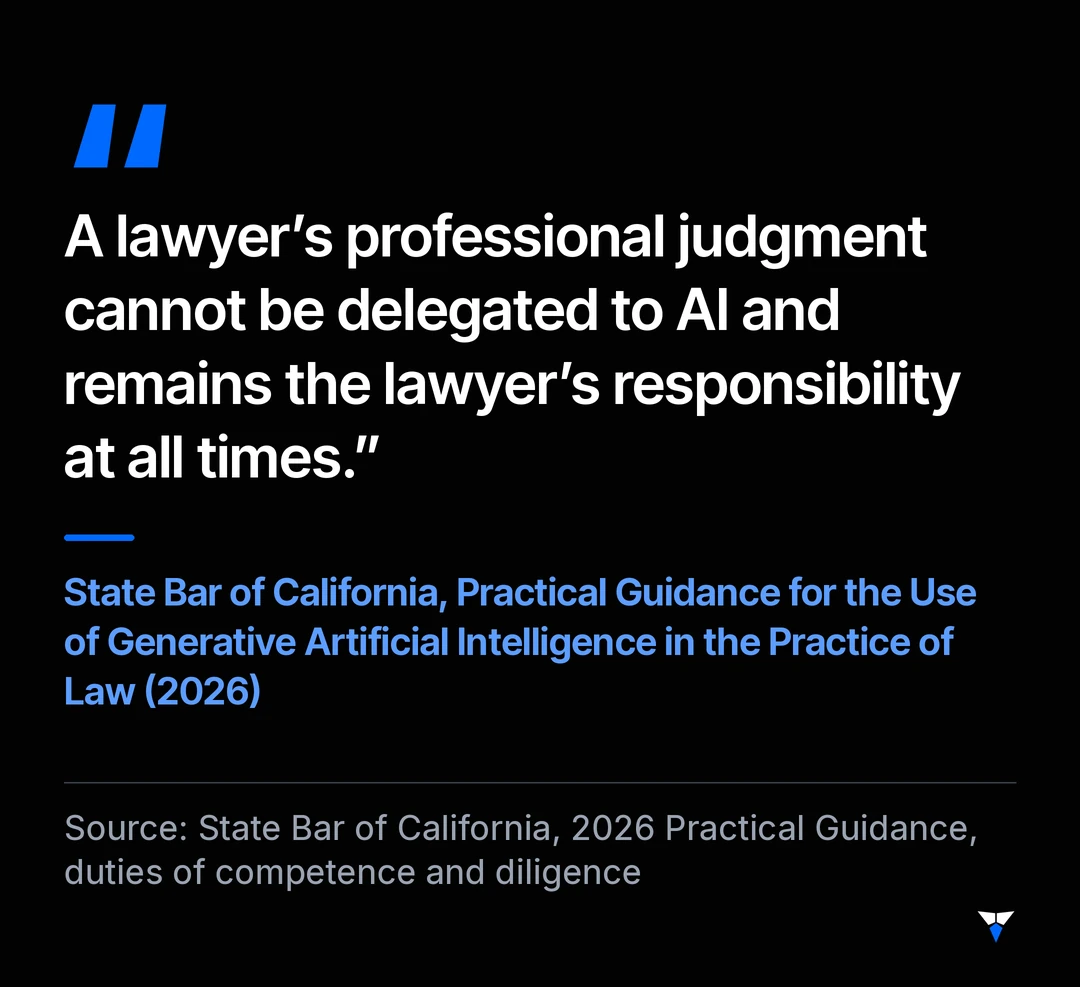
- Competence has two parts. First, “baseline technological competence,” meaning a reasonable understanding of the system’s “capabilities, data sources, limitations, and material risks and benefits before deploying it.” Second, independent judgment: “reviewing, verifying, and correcting AI-generated outputs.” The guidance adds that “A lawyer’s professional judgment cannot be delegated to AI and remains the lawyer’s responsibility at all times.”
- Confidentiality means reading the terms. A lawyer should take reasonable steps to understand how a product “collects, uses, stores, and discloses information,” and “Reasonable efforts require more than reliance on generalized marketing assurances.” As a general matter, a lawyer must not input confidential client information into a tool “that may present material risks to confidentiality or security, absent informed client consent.”
- Talk to clients. A lawyer “must consider disclosure to their client that they intend to use AI in the representation, including how the technology will be used, and the benefits and risks of such use.” They must also follow client instructions that restrict AI use.
- Billing. A lawyer may charge for actual time spent, for example “crafting or refining generative AI inputs and prompts, or reviewing and editing generative AI outputs.” Subscriptions for general office functions “typically constitute overhead” and “should be absorbed within the lawyer’s fee.” Per-use fees for specialized tools used on a specific matter can be charged if the fee agreement discloses it, the charge reflects actual cost, and there’s no markup without the client’s informed written consent.
- Court filings. “The lawyer’s duty of candor to the tribunal cannot be delegated to AI.” A lawyer must review all AI outputs, including analysis and citations, before submission.
Can a California lawyer use an AI agent?
Yes, with a human gate on anything that leaves the office. The 2026 guidance defines agentic systems as tools that “can pursue goals, ‘plan,’ select tools, and even execute tasks without immediate human intervention,” and gives client intake as one example.
It is direct about the limits:
- “Lawyers must not deploy agentic systems in a manner that allows the system to make substantive legal determinations, communicate legal advice, prepare and file pleadings, or otherwise act in a representative capacity without meaningful lawyer supervision and review.”
- Agents connected to email, documents or calendars raise “acute confidentiality considerations,” and lawyers “must carefully evaluate and limit the scope of such access.”
- A lawyer “must not deploy an agentic AI system in a manner that permits autonomous external transmission of client information, including automated communications, filings, or data transfers, without appropriate safeguards and human review.”
- For court filings, lawyers “must ensure that no document is transmitted to the court without lawyer review and approval.”
Our house rule when we set up agents for lawyers matches this: the AI may draft, sort and summarize; a lawyer approves anything that leaves the office. That’s our practice, not a rule from the State Bar.
How do SB 574 and the State Bar guidance compare?
This table maps each topic to its source. The right column is our practical advice, not a legal rule.
| Topic | SB 574 (statute, from Jan 1, 2027) | 2026 Practical Guidance (State Bar) | Our practical advice |
|---|---|---|---|
| Who’s responsible | “Shall not delegate the practice of law to generative artificial intelligence” | Professional judgment “cannot be delegated to AI” | Treat every AI output as a junior’s first draft |
| Confidential data | Not into systems whose access isn’t restricted to you and authorized people bound to confidentiality | Understand how the tool collects, uses, stores and discloses data; informed consent where there’s material risk | Use a business plan with training turned off, and read its data terms |
| Verification | Reasonable steps to verify outputs, including all case and statutory citations | Review, verify and correct outputs | Open every cited case yourself before it goes anywhere |
| Court filings | Disclose AI use to the court for all documents submitted; citations personally verified by the responsible attorney (CCP 128.7) | No document to the court without lawyer review and approval | Add an AI disclosure line to your filing template now |
| Clients | Not addressed for client communications; consider disclosure for public content | Must consider disclosing intended AI use, how, and benefits and risks | Add an AI paragraph to your engagement letter |
| Billing | Not addressed | Bill actual time; general AI subscriptions are overhead; matter-specific costs at actual cost | Keep AI subscriptions out of client invoices |
| Agents | Covered by the same duties | No autonomous legal advice, filings or external transmission without review | Agents draft; you send |
What should a California solo do before January 1, 2027?
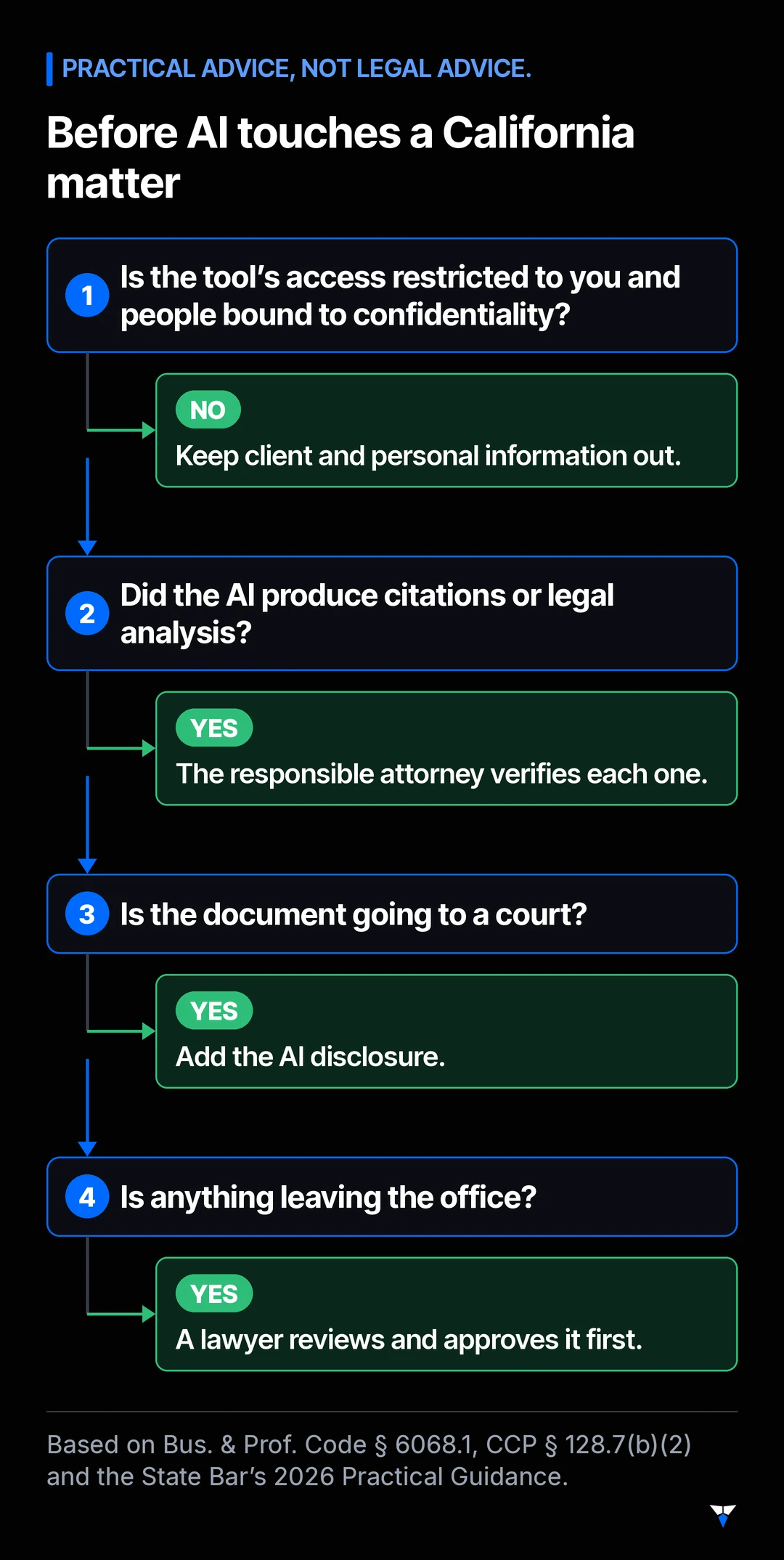
These are the steps we work through with a solo lawyer. They’re practical advice built on the sources above, not legal requirements.
- List every AI tool you touch. Include the AI inside tools you already use. The guidance notes that research platforms and practice management tools may “incorporate some level of AI, even when not traditionally thought of as AI or labeled as such.”
- Check each tool’s data terms. For each one, write down whether inputs are used for training, who can access them and how long they’re kept. Section 6068.1 turns on whether access to what you enter is restricted.
- Move client work to a restricted account. Keep personal identifying information (the statute’s list) out of any consumer or free tool.
- Build a citation check. The responsible attorney opens and reads every cited authority before filing. Section 128.7(b)(2) says “personally verified.”
- Add a court disclosure line. Draft a short, standard sentence for documents where you used generative AI, and check any local rules or standing orders in your courts too.
- Update your engagement letter. Say how you use AI, what data goes in, and how it affects billing.
- Gate your agents. Drafts go to a review folder or your outbox. Nothing is sent, filed or shared without your approval.
- Write a one-page AI policy. Even a solo with one assistant needs one. The guidance says managerial lawyers “should establish clear policies regarding the uses of generative AI,” with training for staff.
- Put a reminder in your calendar. The proposed rule comments may be approved later. Check the State Bar’s page every quarter.
Where to go from here
If you also practice in other states, compare our guides to Texas Ethics Opinion 705 and the Florida Bar’s AI rules. If you record client calls, our AI notetaker guide for lawyers covers California’s all-party consent rule.
Setting up a restricted AI account, a citation-check routine, a court disclosure template and an agent that drafts but never sends is exactly what we do in a 1-hour, 1:1 AI setup session ($100). We set it up with you on video, in your own accounts, and you leave with a written plan. Not sure it fits your practice? Book the free 15-minute fit call first.
Sources
- California Legislature, SB 574 (Umberg), Chapter 858, Statutes of 2026, adding Business and Professions Code section 6068.1 and amending Code of Civil Procedure section 128.7 (approved by the Governor September 30, 2026)
- California Constitution, article IV, section 8 (effective date of statutes)
- The State Bar of California, Practical Guidance for the Use of Generative Artificial Intelligence in the Practice of Law (2026)
- The State Bar of California, Ethics News (Board of Trustees approval on May 14, 2026)
- The State Bar of California, Board of Trustees agenda item 6.3 (May 14, 2026)
- The State Bar of California, Proposed Amendments to the Rules of Professional Conduct Related to Artificial Intelligence (public comment page; checked October 22, 2026)
Frequently asked questions
What is California SB 574?
SB 574 (Umberg) is a California law approved by the Governor on September 30, 2026 (Chapter 858, Statutes of 2026). It adds Business and Professions Code section 6068.1, which says an attorney "shall not delegate the practice of law to generative artificial intelligence" and sets duties on confidentiality, verification and court disclosure. It also amends Code of Civil Procedure section 128.7 so filed papers can't contain citations the responsible attorney hasn't personally verified.
When does SB 574 take effect?
January 1, 2027. SB 574 is not an urgency statute, and under the California Constitution (article IV, section 8(c)) a statute enacted at a regular session takes effect on January 1 after a 90-day period from enactment.
Is the State Bar's 2026 AI guidance binding?
It is guidance, not a rule. The Board of Trustees approved the 2026 Practical Guidance on May 14, 2026, and it explains how existing duties apply to AI. Proposed AI comments to rules 1.1, 1.4, 1.6, 3.3, 5.1 and 5.3 are still in process, and the State Bar's staff report says any rule changes would ultimately require Supreme Court adoption. SB 574, by contrast, is a statute.
Can a California lawyer put client information into ChatGPT?
Be careful. From January 1, 2027, section 6068.1 says not to enter confidential, personal identifying and other nonpublic information into a generative AI system unless access to what you enter is restricted to you and people you've authorized who must keep it confidential. The 2026 guidance also says not to input confidential client information into a tool that may present material risks to confidentiality or security, absent informed client consent.
Do California lawyers have to disclose AI use?
To the court, yes, from January 1, 2027: section 6068.1 requires disclosing generative AI use "to the court for all documents submitted to the court." To clients, the 2026 guidance says a lawyer must consider disclosure of intended AI use, including how it will be used and its benefits and risks. For content provided to the public, the statute asks you to consider whether to disclose.

Written by Ayoub El Mardi
Co-founder, Spark Tech
Ayoub co-founded Spark Tech, an AI and automation consultancy in Marrakech, and works directly with every client from the first call to handover.
Want AI set up for your work?
One 1:1 video hour with a founder to set up AI for your admin. $100, paid when you book.
Get plain-English AI tips for your business
Simple guides to using AI for your admin, written by the two founders. No spam; about one email a month.