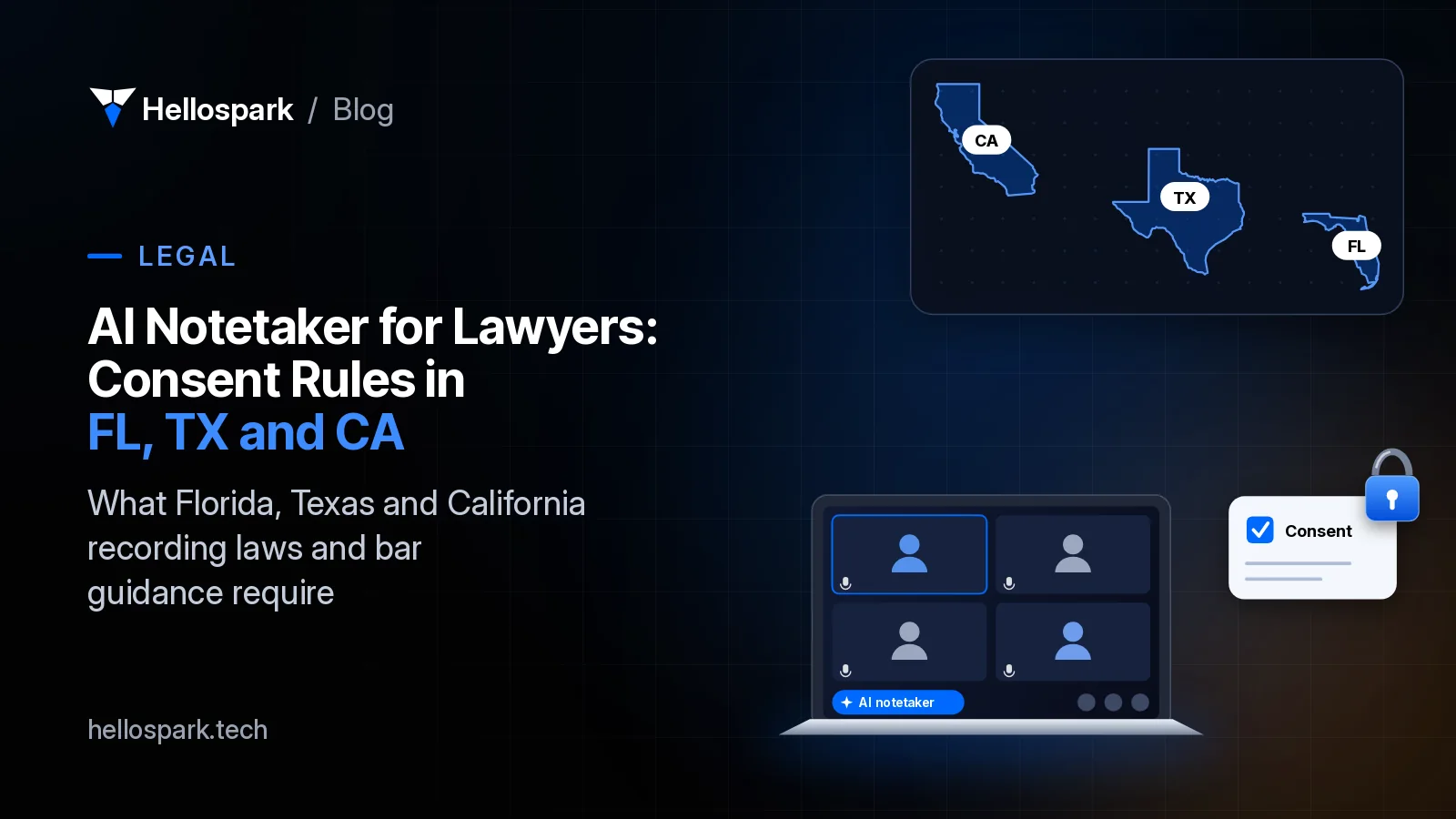
AI Notetaker for Lawyers: Consent Rules in FL, TX and CA
AI notetaker for lawyers: what Florida, Texas and California recording laws and bar guidance require before AI records and summarizes client calls.

Ayoub El Mardi · Co-founder, Spark Tech
12 min read · · Updated
Last updated
Updated : named Hellospark in the intro disclaimer (brand rule).
Earlier updates (3)
- : named Spark Tech in the intro disclaimer for brand clarity in AI answers.
- : added a Florida answer up top, Florida's penalties for recording without consent, and links to our California guide.
- : added four explanatory visuals.
Disclaimer. This article is general information for lawyers about technology. It is not legal or ethics advice. Hellospark is a technology consultancy, not a law firm. Recording laws and ethics rules differ by state and change over time: read the statute and your bar's guidance for every jurisdiction involved, and contact your bar's ethics hotline with specific questions.
In this article · 10 sections
- Can a Florida attorney use an AI notetaker on client calls?
- What is an AI notetaker, and why do bars care?
- Do you need everyone’s consent to use an AI notetaker on a client call?
- Is one-party consent in Texas enough?
- What does the Otter.ai lawsuit mean for choosing a notetaker?
- What should attorneys check before turning on an AI notetaker?
- What if the client brings their own AI notetaker?
- How do you set up AI note taking for a law practice?
- Where to go from here
- Sources
- Frequently asked questions
Writing up client calls is classic evening work for a solo lawyer. An AI notetaker for lawyers can join a client call, record it, transcribe it and hand you a summary before you’ve closed the laptop. That’s a real way to get your evenings back.
It also raises two questions: do I need everyone’s consent, and is my client’s information safe with the vendor? This guide answers both for Florida, Texas and California.
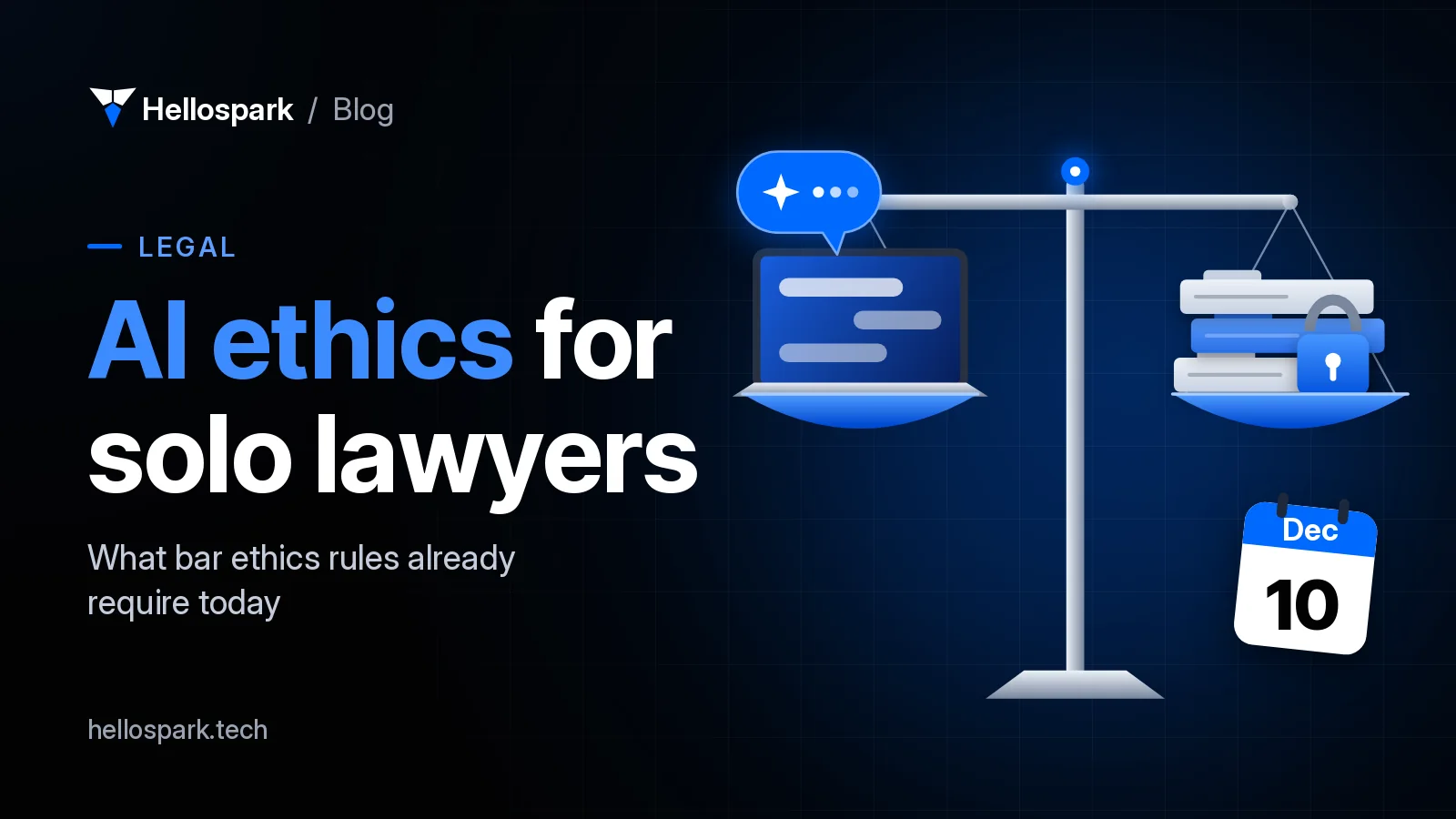
On October 15, 2026, The Florida Bar announced that its ethics committee will consider a new AI opinion on December 10 that may cover “the use of artificial intelligence tools to record, transcribe, and summarize communications.”
Hellospark, a small AI consultancy for US solo professionals, explains how these tools work and what the statutes and bar texts say. We are not a law firm. The legal and ethics calls are yours and your bar’s.
Can a Florida attorney use an AI notetaker on client calls?
Yes, with two conditions. First, the recording law: Florida makes it lawful to record a call only “when all of the parties to the communication have given prior consent” (Fla. Stat. 934.03(2)(d)). Recording without that consent is a third-degree felony under 934.03(4)(a), and section 934.10 lets the person recorded sue for at least $100 a day or $1,000, whichever is higher, plus punitive damages and attorney’s fees.
Second, the ethics rule: Opinion 24-1 asks you to research the tool’s data retention, data sharing and self-learning policies, and recommends informed client consent before confidential information goes to a third-party AI tool. Our Florida consent guide covers when 24-1 consent applies.
In practice: ask everyone at the start of the call, note the answer in the file, and use a vendor that doesn’t train on your calls. The Florida Bar’s Dec 10, 2026 meeting may add rules for these tools; there are no drafts yet.
What is an AI notetaker, and why do bars care?
- AI notetaker
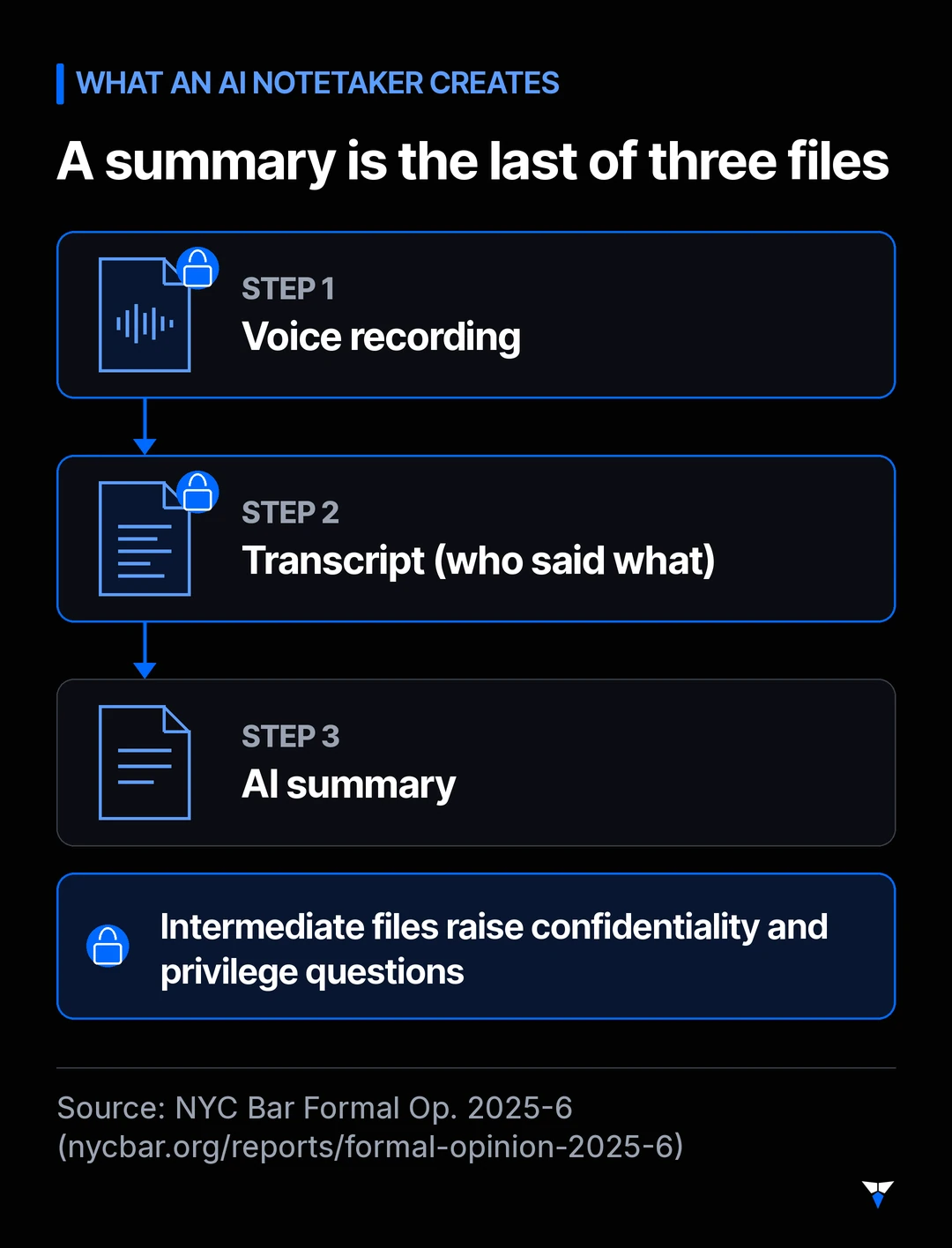
- Software that joins or listens to a call, records the audio, turns it into a transcript that labels who said what, and uses generative AI to write a summary.
- All-party consent
- A recording law that requires everyone on the call to agree before it's recorded. Florida and California work this way (California for confidential communications).
- One-party consent
- A recording law that allows recording if one person on the call, which can be you, consents. Texas works this way.
- Voiceprint
- A record of the features of someone's voice. Texas lists it as a "biometric identifier," and the NYC Bar notes that AI transcription tools use voiceprints derived from audio files of recorded conversations.
Bars care because a notetaker doesn’t just take notes. The NYC Bar’s Formal Opinion 2025-6 (December 22, 2025), the most detailed bar opinion we found on these tools, points out that the summary is the end product of a voice recording and a transcript. Those intermediate files raise confidentiality and privilege questions that a handwritten memo never did.
Do you need everyone’s consent to use an AI notetaker on a client call?
It depends on the state’s recording law, and then on ethics. Here is what each state’s statute and bar guidance say.
| State | Recording law (statute text) | Bar guidance that applies to the vendor | Practical takeaway |
|---|---|---|---|
| Florida | Section 934.03(2)(d): interception is lawful “when all of the parties to the communication have given prior consent” | Opinion 24-1: research the program’s policies on data retention, data sharing and self-learning; informed client consent is recommended before using a third-party generative AI program if it would involve disclosing confidential information | Ask every participant before you record, and note the answer |
| Texas | Penal Code 16.02(c)(4): a defense if the person is a party to the communication, or one party has given prior consent, unless it’s for an unlawful act | Opinion 705: if you aren’t reasonably satisfied the tool will protect confidential information, at a minimum don’t input it without client consultation and consent | Legal to record your own call, but still tell the client and ask (see the next section) |
| California | Penal Code 632: no recording a confidential communication “without the consent of all parties” | 2026 Practical Guidance: don’t input confidential client information into a generative AI solution that may present material risks to confidentiality or security, absent informed client consent Our California AI guidance checklist covers the rest. | Treat every client call as confidential and get everyone’s consent first |
California’s statute defines a “confidential communication” as one carried on in circumstances that reasonably indicate a party wants it confined to the parties. In our reading, most client calls fit that description.
Calls across state lines add a twist. The NYC Bar warns that “AI tools are not yet capable of determining when recordings would violate these varying laws,” and that attorneys “should therefore not rely on AI to determine whether recording is permitted by state substantive law.”
Practical advice, not a rule from any of these sources: if anyone on the call might be in Florida or California, use the all-party consent approach for everyone.
Is one-party consent in Texas enough?
For the criminal statute, often yes: Texas Penal Code 16.02 gives a defense when you are a party to the call. But the statute is not the only question.
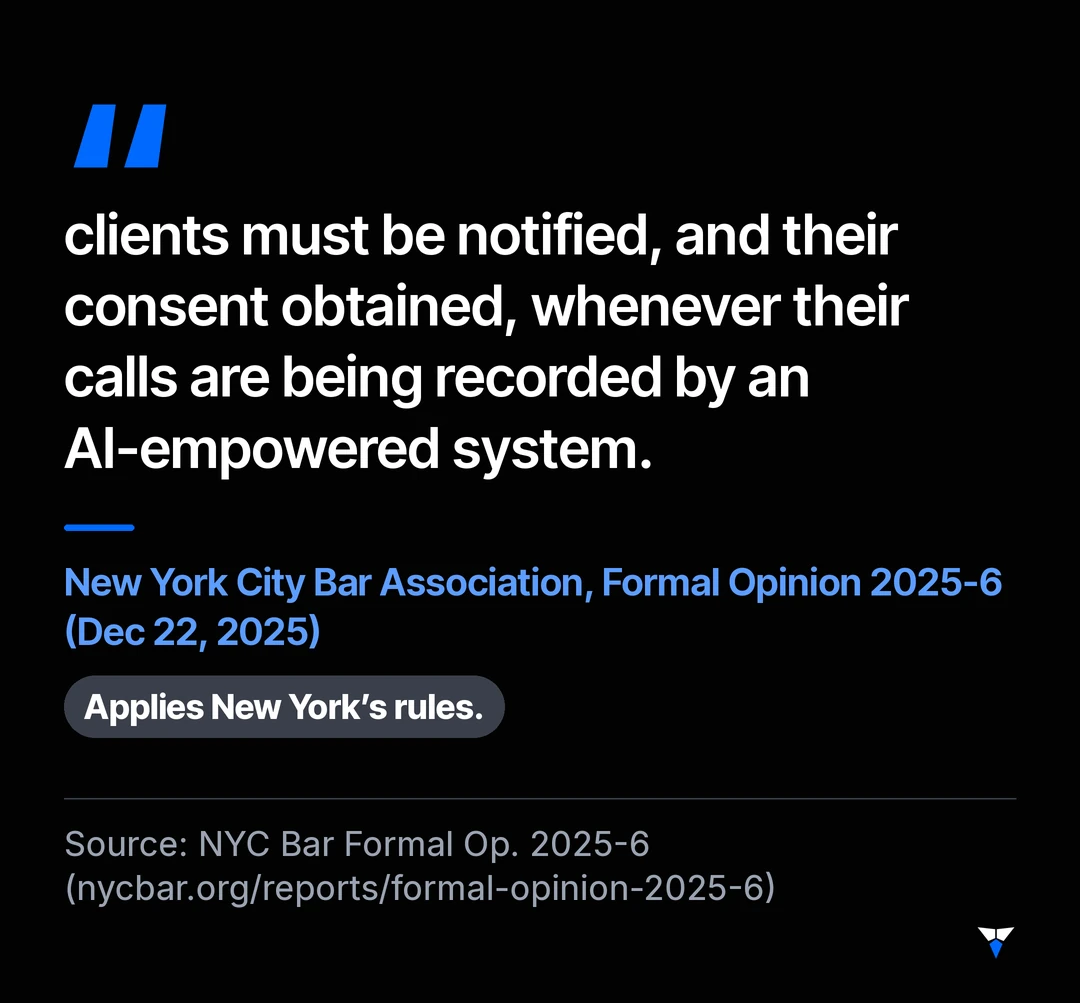
Ethics. New York is also generally a one-party consent state, as the NYC Bar opinion notes (footnote 4, citing N.Y. Penal Law 250.00), and the NYC Bar still concluded that “clients must be notified, and their consent obtained, whenever their calls are being recorded by an AI-empowered system.” Its reasoning rests on the duty of loyalty, the rule against deceptive conduct, and the point that clients may speak differently if they know they are being recorded. That opinion applies New York’s rules, not Texas’s, and we didn’t find a Texas opinion on AI notetakers specifically. It’s still the clearest reasoning available on the question.
Confidentiality. Texas Opinion 705 (February 2025) says that with any generative AI tool, the lawyer “should be reasonably satisfied that the program will not reveal confidential information to others.” If not, the lawyer should “at a minimum—not input any confidential information to the program without client consultation and consent.” A recorded client call is confidential information. For everything else Opinion 705 requires, see our Texas Ethics Opinion 705 guide.
Voiceprints. Texas’s biometric law, Business and Commerce Code 503.001, says a person “may not capture a biometric identifier of an individual for a commercial purpose” unless the person informs the individual first and receives their consent. “Voiceprint” is on its list. Whether a given notetaker’s speaker labels count as capturing voiceprints is an open question we can’t answer for you, so ask your vendor how speaker identification works.
What does the Otter.ai lawsuit mean for choosing a notetaker?
It shows that the vendor’s own data practices matter, not just your consent script.
On August 13, 2026, a federal judge in San Jose partly denied Otter.ai’s motion to dismiss a proposed class action, In re Otter.ai Privacy Litigation. The complaint alleges that Otter records conversations on platforms like Zoom and Microsoft Teams without obtaining consent from all meeting participants. These are allegations at an early stage, not findings.
The reasoning is the useful part. Otter argued its notetaker joins meetings as an invited participant and works as the host’s recording tool. The court noted that software acting only as an extension of its user isn’t a third-party interceptor. But because the plaintiffs allege that Otter “independently collects, retains, and uses communications for its own commercial purposes,” including to improve its machine learning models, the court found they had plausibly alleged Otter is a third-party eavesdropper under California law.
For a law practice, the lesson is practical: a notetaker that keeps your client calls and trains on them is a different risk from one that only works for you.
What should attorneys check before turning on an AI notetaker?
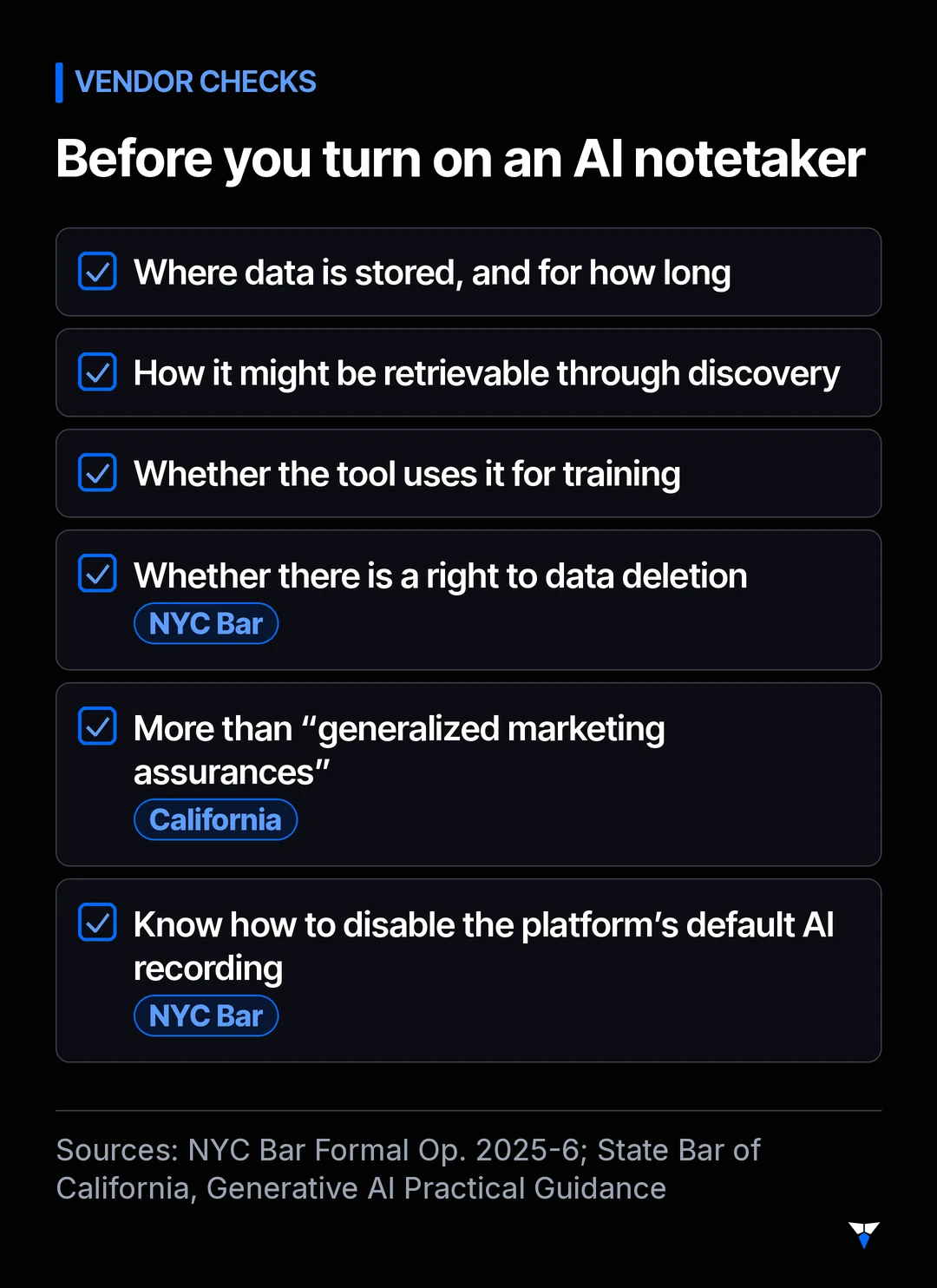
The bars ask the same core questions about any AI vendor. The NYC Bar lists the ones specific to recordings: where data will be stored and for how long, how it might be retrievable through discovery, whether the tool uses it for training, and whether there is a right to data deletion.
California adds a warning that’s easy to miss: “a user may agree to the terms of use and privacy policy simply by using the product,” and reasonable efforts “require more than reliance on generalized marketing assurances.”
The NYC Bar also says you should know how to disable a video platform’s default AI recording feature, and what to do if a conversation is recorded by mistake, for example deleting it with the client’s permission.
What if the client brings their own AI notetaker?
This one is harder, because the recording isn’t under your control. The NYC Bar says the ideal is for clients to agree not to record calls with their own AI tools without advance notice. If they insist, it suggests:
- asking that conversations not be recorded;
- retainer terms saying recordings, transcripts or summaries made by the client’s AI tools “will not be deemed dispositive or binding” against you unless they are promptly provided to you for review; and
- warning clients about the risk of losing confidentiality and privilege.
Florida may weigh in here too: one of the four topics for the Bar’s Dec 10 meeting is guidance for clients on their own use of AI tools.
How do you set up AI note taking for a law practice?
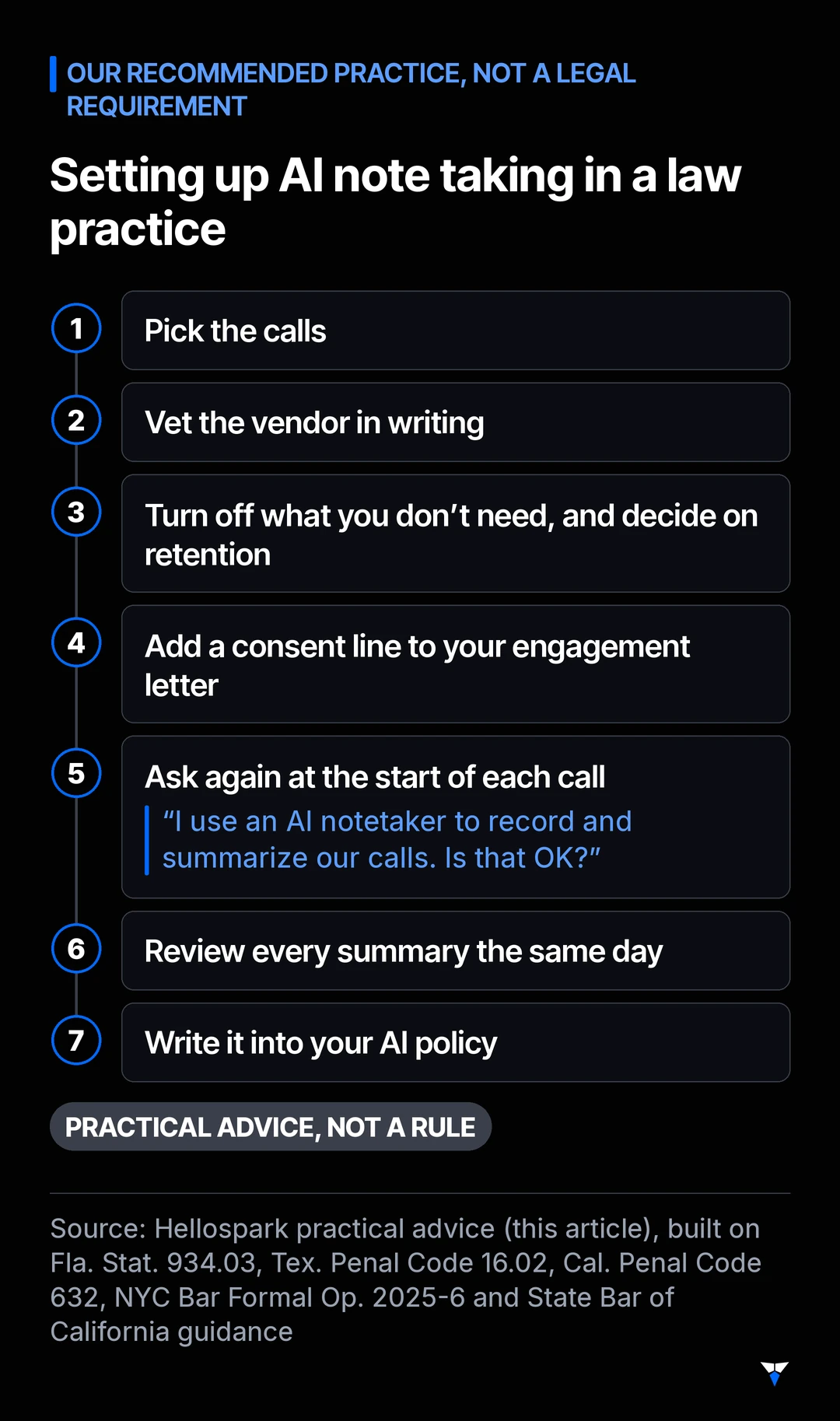
This is the order we follow when we set up a notetaker with a solo lawyer. It’s practical advice built on the sources above, not a legal requirement.
- Pick the calls. Start with internal calls and admin calls. Decide case by case for sensitive client calls, since the NYC Bar asks whether recording is “tactically well-advised in the particular circumstances.”
- Vet the vendor in writing. Check retention, training on your data, deletion, who at the vendor can access recordings, and two-factor sign-in. Save a copy of the terms you accepted.
- Turn off what you don’t need, and decide on retention. Disable auto-join and auto-record, and switch off training on your data if the plan allows it. Decide in advance whether you keep the raw audio and transcript. The NYC Bar notes there are risks in preserving recordings and competing risks in not doing so, and that a policy not to retain them should be disclosed and strictly followed.
- Add a consent line to your engagement letter. Say in plain words that you may use an AI tool to record and summarize calls, what it stores and for how long, and that the client can say no. There’s no official consent form in the sources above. A plain line in the engagement letter plus a spoken check at the start of each call covers what they ask.
- Ask again at the start of each call. One sentence is enough: “I use an AI notetaker to record and summarize our calls. Is that OK?” Record the answer in the matter file. The NYC Bar says that unless the platform gives clear notice, the client should be notified and consent obtained each time a call is recorded.
- Review every summary the same day. Correct it before it goes into the file. The NYC Bar says attorneys should not simply rely on AI work product without independently verifying its accuracy, and should carefully review any informal advice the summary captures.
- Write it into your AI policy. Which notetaker is approved, which calls it may join, and who reviews summaries. Revisit after December 10 if you practice in Florida.
Done this way, the notetaker drafts the memo, you keep the judgment, and the after-hours write-ups shrink.
Where to go from here
For the wider Florida picture, including billing and chatbots, read Florida Bar AI rules: an Opinion 24-1 checklist for solo lawyers. If you also work with therapists or other clinicians, our guide to AI note-takers under the new therapy laws covers their consent rules.
Practicing in California? Read our California State Bar AI guidance and SB 574 checklist. For the other setups we do for lawyers, like intake templates and client email drafts, see what we set up for lawyers.
Setting up a notetaker with the right settings, a consent line and a review habit is exactly what we do in a 1-hour, 1:1 AI setup session ($100). We set it up with you, in your own accounts, and you leave with a written plan. Not sure it fits your practice? Book the free 15-minute fit call first.
Sources
- The Florida Bar, Proposed advisory opinion on Artificial Intelligence tools (October 15, 2026)
- The Florida Bar, Ethics Opinion 24-1 (January 19, 2024)
- Florida Statutes, Section 934.03, Interception and disclosure of wire, oral, or electronic communications prohibited
- Florida Statutes, Section 934.10, Civil remedies
- Texas Penal Code, Section 16.02, Unlawful interception, use, or disclosure of wire, oral, or electronic communications
- Texas Business and Commerce Code, Section 503.001, Capture or use of biometric identifier
- Professional Ethics Committee for the State Bar of Texas, Opinion 705 (February 2025)
- California Penal Code, Section 632
- The State Bar of California, Practical Guidance for the Use of Generative Artificial Intelligence in the Practice of Law (2026)
- New York City Bar Association, Formal Opinion 2025-6: Ethical Issues Affecting Use of AI to Record, Transcribe, and Summarize Conversations with Clients (December 22, 2025)
- U.S. District Court, N.D. California, In re Otter.ai Privacy Litigation, No. 25-cv-06911-EKL, Order Granting Motion to Dismiss in Part (August 13, 2026)
Frequently asked questions
Can a Florida attorney use an AI notetaker on client calls?
Yes, if everyone on the call gives prior consent. Florida Statutes 934.03(2)(d) makes recording lawful only when all parties have given prior consent, and Florida Bar Opinion 24-1 recommends informed client consent before confidential information goes into a third-party AI tool. Check the vendor's data retention, sharing and training policies first. The Florida Bar will consider a new AI opinion on December 10, 2026 that may cover these tools.
Do I need consent to use an AI notetaker on a client call?
In practice, yes. Florida's statute makes interception lawful when all parties have given prior consent, and California bans recording a confidential communication without the consent of all parties. Texas allows recording by a party to the call, but the NYC Bar's Formal Opinion 2025-6 concludes that clients must be notified, and their consent obtained, whenever their calls are being recorded by an AI-empowered system. The simplest habit is to ask everyone on every call and note the answer.
Is Texas one-party consent enough for an AI notetaker?
For the criminal statute, Texas Penal Code 16.02 gives a defense when the person recording is a party to the communication or one party has given prior consent. Ethics is a separate question: Texas Opinion 705 says that if you are not reasonably satisfied a tool will protect confidential information, you should at a minimum not input it without client consultation and consent. Texas also has a biometric law that covers voiceprints, so ask your vendor whether it creates them.
What happens if a call has people in more than one state?
The rules can differ for each participant. The NYC Bar warns that AI tools are not yet capable of determining when recordings would violate these varying laws, and that attorneys should not rely on AI to determine whether recording is permitted. Our practical advice: when callers may be in Florida or California, follow the all-party consent rule for everyone.
What does the Otter.ai lawsuit mean for lawyers choosing a notetaker?
It shows that the vendor's own data practices matter, not just your consent script. On August 13, 2026, a federal judge partly denied Otter.ai's motion to dismiss a proposed class action. The court found the plaintiffs had plausibly alleged Otter is a third-party eavesdropper under California law because it allegedly collects, retains and uses communications for its own commercial purposes. These are allegations at an early stage, not findings.
What should I check about an AI notetaker vendor before using it?
The NYC Bar lists where data will be stored and for how long, how it might be retrievable through discovery, whether the tool uses it for training, and whether there is a right to data deletion. California adds that reasonable efforts require more than reliance on generalized marketing assurances.
What should I do if a client records our call with their own AI notetaker?
The NYC Bar suggests asking that conversations not be recorded, adding retainer terms saying client-made AI recordings or summaries are not binding on you unless you get them promptly to review, and warning clients about the risk of losing confidentiality and privilege.
Will the Florida Bar issue a rule on AI notetakers?
Possibly. On October 15, 2026, The Florida Bar said its ethics committee will consider a proposed advisory opinion at a meeting on December 10, 2026, and that it may cover the use of AI tools to record, transcribe and summarize communications. The Bar said there were no drafts at that time. It may also give guidance on clients' own use of AI tools.
What happens if you record a call in Florida without consent?
Under Florida Statutes 934.03(4)(a), an unlawful interception is a third-degree felony, with a narrow exception for some radio interceptions. Section 934.10 also lets the person recorded sue for actual damages of at least $100 a day or $1,000, whichever is higher, plus punitive damages and attorney's fees.
Do I need a consent form for an AI notetaker?
None of the sources we cite requires a specific form. The NYC Bar says that unless the platform gives clear notice, the client should be notified and consent obtained each time a call is recorded. A plain line in your engagement letter plus a spoken check at the start of each call, noted in the file, covers that.

Written by Ayoub El Mardi
Co-founder, Spark Tech
Ayoub co-founded Spark Tech, an AI and automation consultancy in Marrakech, and works directly with every client from the first call to handover.
Want AI set up for your work?
One 1:1 video hour with a founder to set up AI for your admin. $100, paid when you book.
Get plain-English AI tips for your business
Simple guides to using AI for your admin, written by the two founders. No spam; about one email a month.